Significant Data Fiduciary Under DPDP Act

Listen to This Article
In today’s data-driven world, personal information has become one of the most valuable assets. With the rise of digital platforms, protecting this data is no longer optional—it is a legal and ethical necessity. India took a major step in this direction with the Digital Personal Data Protection (DPDP) Act, 2023.
Get a callback
Among its most important concepts is the idea of a Significant Data Fiduciary (SDF)—a special category of organizations that carry higher responsibility due to the scale and sensitivity of data they handle.
This blog will break down everything you need to know about Significant Data Fiduciaries in a clear, engaging, and practical way.
What is a Data Fiduciary?
Before understanding Significant Data Fiduciaries, let’s start with the basics.
A Data Fiduciary is any person, company, or entity that determines:
Why personal data is processed (purpose), and
How it is processed (means)
In simple terms, if you collect or use personal data, you are a Data Fiduciary.
Who is a Significant Data Fiduciary (SDF)?
A Significant Data Fiduciary is a Data Fiduciary that is classified as “significant” by the Government of India based on certain risk factors.
This classification is not automatic—it is notified by the government after evaluating multiple parameters.
Criteria for Classification as SDF
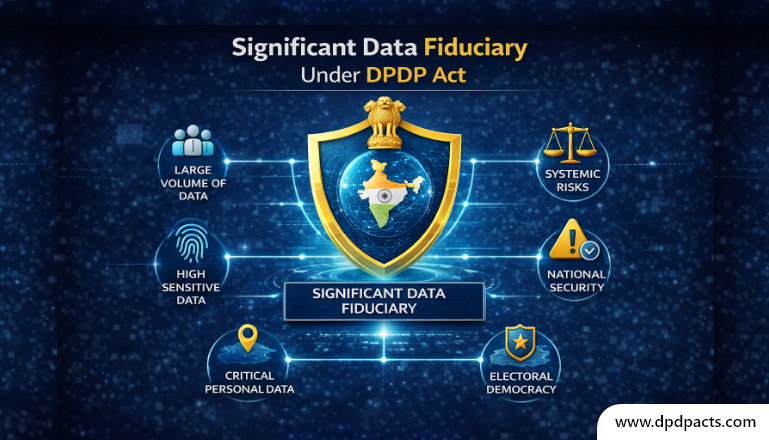
The government may designate a Data Fiduciary as “Significant” based on:
- Volume of Data Processed
Organizations handling large volumes of personal data are more likely to be classified as SDFs.
- Sensitivity of Data
If the data includes:
- Financial details
- Health records
- Biometric data
…the risk increases significantly.
- Risk to Rights of Individuals
If misuse or breach of data can harm individuals’ rights, dignity, or safety, the entity may be categorized as SDF.
- Impact on Sovereignty & Security
Entities whose data processing could affect:
- National security
- Public order
are strong candidates for SDF classification.
- Use of Emerging Technologies
Organizations using:
- AI
- Machine learning
- Large-scale profiling
may also fall under this category due to increased risk.
Key Obligations of Significant Data Fiduciaries
Once classified as an SDF, the organization must comply with stricter requirements.
- Appointment of a Data Protection Officer (DPO)
- Must be based in India
- Acts as the point of contact for grievances and compliance
- Independent Data Auditor
- Conducts periodic audits
- Ensures compliance with the DPDP Act
- Data Protection Impact Assessment (DPIA)
- Mandatory before high-risk processing
- Helps identify and mitigate risks
- Enhanced Compliance Measures
- Stronger security safeguards
- More accountability in data processing
- Record Keeping
Detailed documentation of processing activities
Why the SDF Concept Matters
The SDF framework ensures that “greater power comes with greater responsibility.”
It helps:
- Protect citizens’ privacy
- Build trust in digital ecosystems
- Ensure accountability among big data handlers
Without such a system, large corporations and high-risk entities could operate without sufficient checks.
Examples of Potential SDFs
While the government officially notifies SDFs, typical examples may include:
- Large social media platforms
- Financial institutions
- Health-tech companies
- E-commerce giants
- AI-driven analytics firms
Consequences of Non-Compliance
Failing to meet SDF obligations can lead to:
- Heavy financial penalties
- Regulatory scrutiny
- Loss of user trust
- Legal consequences
The DPDP Act introduces strict penalties, emphasizing the seriousness of data protection.
Practical Steps for Businesses
If your organization could fall under the SDF category, here’s what you should do:
- Conduct internal data audits
- Map all data flows
- Strengthen cybersecurity practices
- Train employees on data protection
- Prepare for regulatory scrutiny
Being proactive can save significant time, cost, and reputational damage.
The Future of Data Governance in India
The concept of Significant Data Fiduciary reflects a risk-based regulatory approach, aligning India with global standards like GDPR.
As digital adoption grows, more companies may fall under this category, making compliance a strategic necessity—not just a legal obligation.
Conclusion
The concept of a Significant Data Fiduciary under the DPDP Act, 2023 is a cornerstone of India’s data protection framework. It ensures that organizations handling vast and sensitive data are held to higher standards of accountability.
For businesses, this is not just about compliance—it’s about building trust, safeguarding users, and staying future-ready in a data-first world.
If your organization deals with personal data at scale, now is the time to evaluate your position and prepare for what lies ahead.
FAQs on Significant Data Fiduciary
Q1. What is a Significant Data Fiduciary?
A1. A Significant Data Fiduciary is a Data Fiduciary classified by the government based on the scale, sensitivity, and risk associated with data processing.
Q2. Who decides whether a company is an SDF?
A2. The Central Government of India determines and notifies which entities are SDFs.
Q3. Is every company a Significant Data Fiduciary?
A3. No. Only those meeting specific risk-based criteria are classified as SDFs.
Q4. What is the role of a Data Protection Officer (DPO)?
A4. The DPO ensures compliance, handles grievances, and acts as a bridge between the organization and regulators.
Q5. What is a Data Protection Impact Assessment (DPIA)?
A5. It is a process to identify and minimize risks before undertaking high-risk data processing activities.
Q6. Are startups also considered SDFs?
A6. Yes, if they process large volumes or sensitive data or pose significant risks, they can be classified as SDFs.
Q7. What happens if an SDF fails to comply?
A7. They may face heavy penalties, legal action, and reputational damage.
Q8. Do SDFs need to appoint external auditors?
A8. Yes, they must appoint an independent Data Auditor to evaluate compliance.
Q9. Can a company challenge its SDF classification?
A9. The Act does not explicitly detail a challenge process, but legal remedies may be available.
Q10. Why is the SDF concept important?
A10. It ensures stricter regulation of high-risk entities, protecting individuals’ data and strengthening trust in digital systems.