Are Cross Border Data Transfer Allowed Under DPDP Act

Listen to This Article
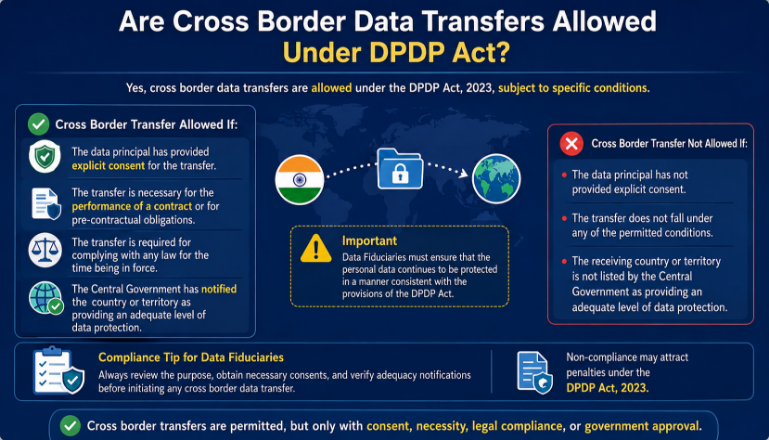
India’s digital economy is now deeply connected with the world. From cloud storage and international payroll systems to AI tools and global customer support platforms, businesses regularly move personal data across borders. As a result, one of the biggest questions after the introduction of the Digital Personal Data Protection Act, 2023 (DPDP Act) is:
Get a callback
Can personal data be transferred outside India under the DPDP Act?
The answer is yes — but with conditions.
Unlike earlier data protection proposals that strongly emphasized data localization, the DPDP Act adopts a more flexible and business-friendly framework. Instead of banning international data movement by default, the law allows cross-border transfers unless the Government of India specifically restricts certain countries or territories.
This approach has major implications for startups, SaaS companies, multinational corporations, fintech businesses, and organizations handling Indian user data.
Understanding Cross-Border Data Transfers
A cross-border data transfer happens when personal data collected in India is accessed, stored, processed, or transferred outside India.
This may include:
- Using international cloud servers
- Sending employee information to a global HR platform
- Processing customer analytics abroad
- Hosting databases in another country
- Outsourcing customer support to overseas teams
Today, almost every digital business relies on some form of international data flow.
For example:
- A startup using AWS Singapore servers
- An Indian e-commerce platform using a US-based CRM
- A fintech company using global fraud detection software
- A multinational corporation maintaining centralized employee databases
Because global digital systems are interconnected, strict localization can become expensive and operationally difficult.
That is why the DPDP Act takes a relatively flexible approach.
What Does the DPDP Act Say About International Data Transfers?
Cross-border data transfers are governed primarily under Section 16 of the DPDP Act, 2023.
The law states that personal data may be transferred outside India except to countries or territories specifically restricted by the Central Government.
This means:
- International data transfers are generally permitted
- No blanket ban on overseas storage exists
- Businesses can continue using global digital infrastructure
- Restrictions apply only if officially notified by the government
This model is often called a “negative list” system or “blacklisting framework.”
Blacklisting Approach Explained
The DPDP Act follows a simple principle:
“Data transfers are allowed unless prohibited.”
Instead of creating a list of approved countries, the Indian government reserves the power to identify countries where transfers may be restricted in the future.
This differs significantly from the European GDPR model.
Under GDPR:
- Transfers are heavily regulated
- Special safeguards are required
- Adequacy assessments are necessary
Under the DPDP Act:
- Transfers are permitted by default
- Restrictions are selective
- Compliance obligations still continue
This makes India’s framework comparatively business-friendly.
Rule 15 of the DPDP Rules, 2025
Rule 15 further strengthens the government’s authority over cross-border data transfers.
Under this rule, the government may:
- Restrict transfers to certain jurisdictions
- Impose conditions on international transfers
- Regulate transfers involving foreign government entities
- Introduce additional compliance requirements
This gives regulators flexibility to address:
- National security concerns
- Strategic interests
- Cybersecurity threats
- Sensitive international relationships
While the framework is liberal today, businesses should understand that restrictions may evolve over time.
Why India Did Not Choose Strict Data Localization
India’s earlier privacy drafts proposed stronger localization mandates. However, the final DPDP Act moved toward a more balanced approach.
There are several reasons behind this shift.
- Global Technology Infrastructure Depends on Cross-Border Data Flow
Modern digital services operate on globally distributed infrastructure.
Companies depend on:
- Cloud computing
- Global cybersecurity tools
- AI platforms
- International software systems
- Remote collaboration tools
Forcing all data to remain in India would significantly increase costs and reduce efficiency.
- India’s IT Industry Relies on International Data Movement
India is one of the world’s largest exporters of digital and IT-enabled services.
Industries such as:
- SaaS
- BPO
- IT services
- Software development
- AI and analytics
all require continuous global data exchange.
A restrictive localization regime could have negatively affected India’s competitiveness.
- International Businesses Prefer Flexible Data Laws
Global companies are more likely to invest in countries where compliance systems are practical and scalable.
The DPDP framework supports:
- Foreign investment
- International expansion
- Cloud innovation
- Startup growth
- Cross-border digital trade
Does the DPDP Act Completely Remove Localization Requirements?
No.
Although the DPDP Act itself does not impose blanket localization, other Indian laws and regulators may still require certain categories of data to remain within India.
This is extremely important for businesses to understand.
Sector-Specific Laws Still Matter
Different industries may continue to face separate localization obligations.
RBI Regulations
The Reserve Bank of India has issued localization requirements for specific payment and financial data.
For example:
- Payment transaction data
- Banking information
- Financial settlement records
may need to be stored within India.
Healthcare and Sensitive Data
Healthcare data may be governed by additional rules relating to medical confidentiality and digital health systems.
Government and Critical Infrastructure Data
Public sector and strategic sectors may face stricter controls regarding storage and international transfers.
Compliance Obligations Continue Even After Transfer
One of the biggest misconceptions is that transferring data outside India reduces compliance responsibility.
That is incorrect.
Even when personal data is processed abroad, the Data Fiduciary remains responsible under the DPDP Act.
Key Responsibilities of Businesses
- Obtain Valid Consent
Organizations must collect lawful and informed consent before processing personal data unless another lawful basis applies.
Users should clearly understand:
- Why data is collected
- How it will be used
- Whether it may be transferred internationally
Consent must be:
- Free
- Specific
- Informed
- Unambiguous
- Implement Security Safeguards
The DPDP Act requires organizations to protect personal data through reasonable security measures.
This may include:
- Encryption
- Access controls
- Network monitoring
- Vendor risk assessments
- Data minimization
- Multi-factor authentication
Cross-border transfer increases cybersecurity exposure, making robust safeguards essential.
- Respect Data Principal Rights
User rights continue even after international transfer.
Organizations must still support:
- Access requests
- Data correction
- Erasure requests
- Consent withdrawal
- Grievance mechanisms
This means companies must maintain operational control over transferred data.
- Manage Third-Party Vendors Carefully
Businesses using foreign service providers should ensure contractual safeguards exist.
Vendor agreements should cover:
- Security obligations
- Breach reporting
- Confidentiality
- Data deletion
- Audit rights
Third-party compliance management is becoming increasingly important under modern privacy laws.
Impact of the DPDP Act on Businesses
The cross-border transfer framework affects nearly every digital business operating in India.
Impact on Startups
Startups benefit significantly because they often depend on affordable global cloud infrastructure.
Without strict localization:
- Infrastructure costs stay lower
- International scaling becomes easier
- Faster deployment is possible
This encourages innovation and entrepreneurship.
Impact on SaaS Companies
Software companies serving international clients can continue using centralized systems across multiple jurisdictions.
This is particularly valuable for:
- HR tech
- CRM platforms
- AI products
- Productivity tools
- Collaboration software
Impact on Multinational Corporations
MNCs can continue integrating Indian operations into global data systems instead of maintaining separate India-only infrastructure.
This improves operational efficiency and compliance consistency.
Challenges and Legal Risks
While the framework is flexible, businesses should still monitor emerging risks.
- Regulatory Uncertainty
The government may restrict countries in the future.
If that happens, companies may suddenly need to:
- Shift infrastructure
- Replace vendors
- Migrate databases
- Update contracts
This uncertainty requires ongoing compliance monitoring.
- International Enforcement Complexity
When data is stored abroad, enforcing Indian privacy rights can become more complicated.
Jurisdictional challenges may arise involving:
- Investigations
- Data access
- Breach response
- Legal enforcement
- Cybersecurity Risks
Cross-border systems may expose organizations to additional cybersecurity threats, including:
- Foreign surveillance
- International hacking attempts
- Third-party vulnerabilities
Security governance therefore becomes critical.
DPDP Act vs GDPR: Key Difference
The Indian DPDP framework is notably more flexible than Europe’s GDPR.
| Feature | DPDP Act | GDPR |
| Transfer Model | Blacklist approach | Adequacy & safeguards |
| Default Position | Transfers allowed | Restricted transfers |
| SCC Requirement | Not mandatory currently | Commonly required |
| Localization | Limited | Not mandatory |
| Compliance Complexity | Moderate | High |
India’s model prioritizes operational flexibility while retaining government oversight powers.
Best Practices for Businesses Handling International Data Transfers
Organizations should proactively strengthen compliance systems.
Conduct Data Mapping
Understand:
- What data leaves India
- Where it is stored
- Which vendors process it
- Why transfers occur
Review International Vendors
Assess vendor security, certifications, and contractual obligations.
Monitor Regulatory Developments
Track future government notifications regarding restricted countries.
Maintain Internal Documentation
Document:
- Transfer purposes
- Security safeguards
- Vendor assessments
- Consent mechanisms
Good documentation improves compliance readiness.
The Future of Cross-Border Data Transfers in India
India’s privacy framework is still evolving.
Future developments may include:
- Country-specific transfer restrictions
- Additional security obligations
- Rules for Significant Data Fiduciaries
- AI governance standards
- Stronger cybersecurity requirements
Businesses should therefore treat compliance as an ongoing process rather than a one-time exercise.
Conclusion
Yes, cross-border personal data transfers are allowed under the DPDP Act, 2023.
India has adopted a modern and business-friendly framework that permits international transfers unless specifically restricted by the government.
This approach supports:
- Digital innovation
- Startup growth
- International business operations
- Cloud-based infrastructure
- Global trade integration
However, organizations must still comply with core obligations relating to:
- Consent
- Security
- User rights
- Vendor governance
- Sector-specific regulations
The DPDP Act may be flexible, but responsible data governance remains essential.
Companies that proactively build strong compliance systems today will be better prepared for India’s evolving privacy landscape tomorrow.
FAQs on Cross-Border Data Transfers Under the DPDP Act
Q1. Are cross-border data transfers legal under the DPDP Act?
A1. Yes, Personal data can generally be transferred outside India unless restricted by the Central Government.
Q2. What is the blacklist approach under the DPDP Act?
A2. The blacklist approach means transfers are allowed to all countries except those specifically prohibited by the government.
Q3. Does the DPDP Act require data localization?
A3. No blanket localization requirement exists under the DPDP Act itself, although sectoral regulations may still apply.
Q4. Can startups use foreign cloud servers?
A4. Yes, Most startups can continue using global cloud infrastructure unless separate regulatory restrictions apply.
Q5. What is Rule 15 of the DPDP Rules?
A5. Rule 15 empowers the government to restrict or regulate international data transfers to certain jurisdictions or entities.
Q6. Do user rights continue after international transfer?
A6. Yes, Data Principal rights such as access, correction, and erasure continue even if data is stored abroad.
Q7. Can the government ban transfers to specific countries?
A7. Yes, The government can notify restricted countries or territories under the DPDP framework.
Q8. Are companies responsible for overseas vendors?
A8. Yes, Data Fiduciaries remain responsible for ensuring lawful processing and adequate safeguards.