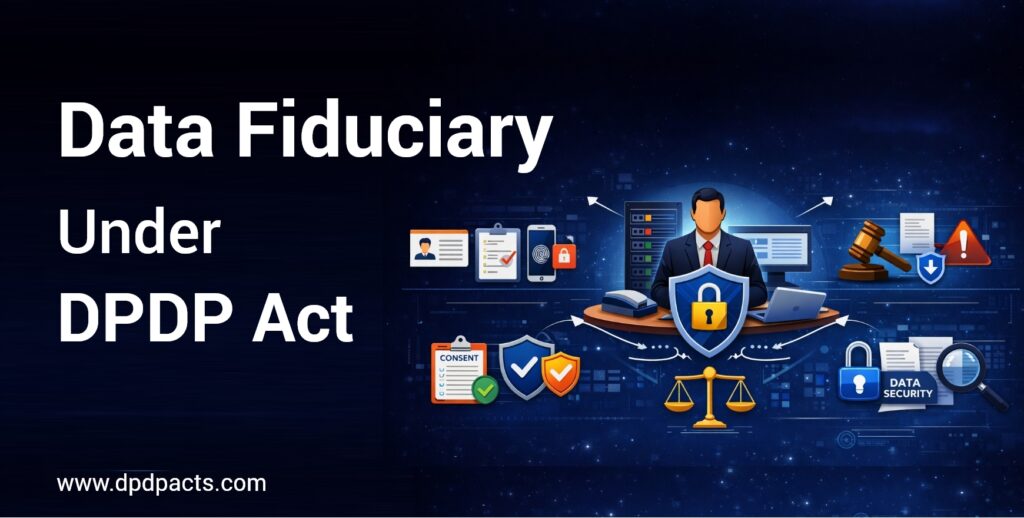
Data Fiduciary Under DPDP Act

- Loading...
In the era of digital transformation, personal data has become one of the most valuable assets. From online shopping to mobile apps and financial transactions, organizations constantly collect and process user data. But with great data comes great responsibility.
Get a callback
This is where the concept of a Data Fiduciary under the DPDP Act becomes crucial.
If you’re a business owner, start-up founder, compliance professional, or simply curious about India’s data protection law, this SEO-friendly guide will help you understand everything in a clear and engaging way.
What is a Data Fiduciary Under the DPDP Act?
Data Fiduciary are those persons, entities or organisations who process the personal data of the data principal and who determine the purpose and means of processing of personal data of the data principal.
Simple Definition:
A Data Fiduciary is any individual, company, or government entity that determines the purpose and means of processing personal data.
Examples:
- E-commerce platforms collecting customer details
- Banks managing financial data
- Healthcare apps storing patient information
- Government portals handling citizen records
Why Data Fiduciaries Matter in the Digital Economy
The Digital Personal Data Protection (DPDP) Act introduces accountability into the data ecosystem. It ensures that organizations treat personal data as a trusted asset, not just a business resource.
Key Benefits:
- Protects user privacy
- Builds consumer trust
- Reduces risk of data breaches
- Ensures legal compliance
Key Responsibilities of a Data Fiduciary
To comply with the DPDP Act, Data Fiduciaries must follow strict obligations:
- Consent Management (Core Requirement)
Before collecting personal data, you must obtain valid consent.
- Clear and transparent
- Specific purpose mentioned
- Easy to withdraw
No misleading or hidden terms allowed.
- Purpose Limitation
Data must be used only for the purpose it was collected.
Example:
If a user signs up for a newsletter, you cannot use their data for marketing campaigns without additional consent.
- Data Accuracy
Organizations must ensure:
- Data is correct
- Data is updated
- Users can correct errors
Incorrect data can lead to legal risks and poor decision-making.
- Security Safeguards
Data Fiduciaries must implement reasonable security practices, such as:
- Encryption
- Firewalls
- Access control systems
- Regular monitoring
Prevention is always better than dealing with a breach.
- Data Breach Notification
In case of a data breach, you must:
- Inform the Data Protection Board of India
- Notify affected users (if required)
- Take immediate corrective action
- Data Retention & Deletion
Once the purpose is fulfilled:
Data must be deleted or anonymized.
Also, if a user withdraws consent, data processing must stop.
- Accountability for Third Parties
If you use vendors or partners (Data Processors):
- You remain responsible
- Contracts must ensure compliance
- Regular audits are necessary
What constitutes a ‘reasonable security safeguard under the DPDP Act for protecting the personal data of a Data Principal?
- Data Protection Techniques
- Encryption
- Masking / Obfuscation
- Tokenisation
- Access Control Measures
- Role-based access
- Authentication mechanisms
- Restricted system access
- Monitoring & Detection
- Maintain logs of access
- Continuous monitoring
- Detect unauthorised access
- Enable investigation & remediation
- Data Backup & Continuity
- Regular backups
- Disaster recovery systems
- Ensure availability even after breach/loss
- Log & Data Retention
- Retain logs and relevant data for minimum 1 year
- Data Processor Contracts
- Include security safeguard clauses in agreements
- Ensure processors follow same standards
- Technical & Organisational Measures
- Internal policies
- Staff training
- Compliance frameworks
- Periodic audits
Data Fiduciary Obligations for Children’s Data
1. Requirement of Verifiable Parental Consent
A Data Fiduciary must obtain verifiable consent from the parent or lawful guardian before processing the personal data of a child or a person with a disability who has a guardian, in the manner prescribed.
2. Protection of Child’s Well-being
A Data Fiduciary must not process a child’s personal data in any manner that is likely to harm or adversely affect the child’s well-being.
3. Prohibition on Tracking and Targeted Advertising
A Data Fiduciary is prohibited from engaging in tracking, behavioural monitoring, or targeted advertising directed at children.
4. Exemptions for Certain Data Fiduciaries or Purposes
The obligations relating to parental consent and restrictions on tracking/advertising may not apply to specified classes of Data Fiduciaries or for certain purposes, subject to conditions prescribed by the government.
5. Government Power to Grant Age-based Exemptions
The Central Government may exempt a Data Fiduciary from some or all obligations under consent and tracking restrictions for children above a specified age, if it is satisfied that such processing is verifiably safe.
6. Implementation of Consent Verification Mechanisms
A Data Fiduciary must adopt appropriate technical and organisational measures to ensure that parental consent is verifiable before processing a child’s data. It must also exercise due diligence to confirm that the individual claiming to be the parent is an identifiable adult.
7. Modes of Verifying Identity and Age
Verification may be carried out using:
- (a) Reliable identity and age information already available with the Data Fiduciary; or
- (b) Information voluntarily provided:
- (i) directly by the individual; or
- (ii) through a virtual token linked to such details and issued by an authorised entity.
What is a Significant Data Fiduciary (SDF)?
The government may classify certain organizations as Significant Data Fiduciaries (SDFs) based on:
- Volume of data processed
- Sensitivity of personal data
- Risk to individuals
- Impact on national security
Additional Compliance for SDFs
If you are categorized as an SDF, you must:
- Appoint a Data Protection Officer (DPO) in India
- Conduct Data Protection Impact Assessments (DPIA)
- Perform regular compliance audits
- Implement stronger governance frameworks
Penalties Under the DPDP Act
Non-compliance can lead to heavy fines.
Maximum Penalty:
Common Violations:
- Data breaches due to poor security
- Processing without valid consent
- Failure to report breaches
- Ignoring user rights
Best Practices for Data Fiduciary Compliance
To stay compliant and build trust:
- Use clear privacy policies
- Collect minimal data (data minimization)
- Train employees on data protection
- Conduct regular audits
- Implement strong cybersecurity measures
- Enable easy consent withdrawal
Real-World Example
A fintech app collecting user data must:
- Take explicit consent before collecting KYC details
- Use data only for financial services
- Secure sensitive information
- Delete data when no longer needed
- Report breaches immediately
Conclusion
The Data Fiduciary under the DPDP Act is not just a legal role—it’s a responsibility to protect user trust in a data-driven world.
Organizations that embrace transparency, accountability, and ethical data practices will not only stay compliant but also gain a competitive advantage.
In the digital age, trust is the new currency—and Data Fiduciaries are its guardians.
FAQs: Data Fiduciary Under DPDP Act
Q1. What is a Data Fiduciary in simple terms?
A1. An entity that decides how and why personal data is processed.
Q2. Is every company a Data Fiduciary?
A2. Yes, if it collects or processes personal data.
Q3. What is valid consent under DPDP?
A3. Consent must be clear, informed, specific, and freely given.
Q4. What is a Significant Data Fiduciary?
A4. An organization with high data volume or risk, requiring additional compliance.
Q5. Can data be processed without consent?
A5. Only in certain legal situations defined under the Act.
Q6. What happens if a data breach occurs?
A6. The Data Fiduciary must report it to authorities and take corrective actions.
Q7. What is the role of a Data Protection Officer?
A7. To ensure compliance and act as a point of contact for data protection matters.
Q8. What is data minimization?
A8. Collecting only the data that is necessary.
Q9. Can users request deletion of their data?
A9. Yes, users have the right to withdraw consent and request deletion.
Q10. What are the penalties for non-compliance?
A10. Fines can go up to ₹250 crore depending on the violation.