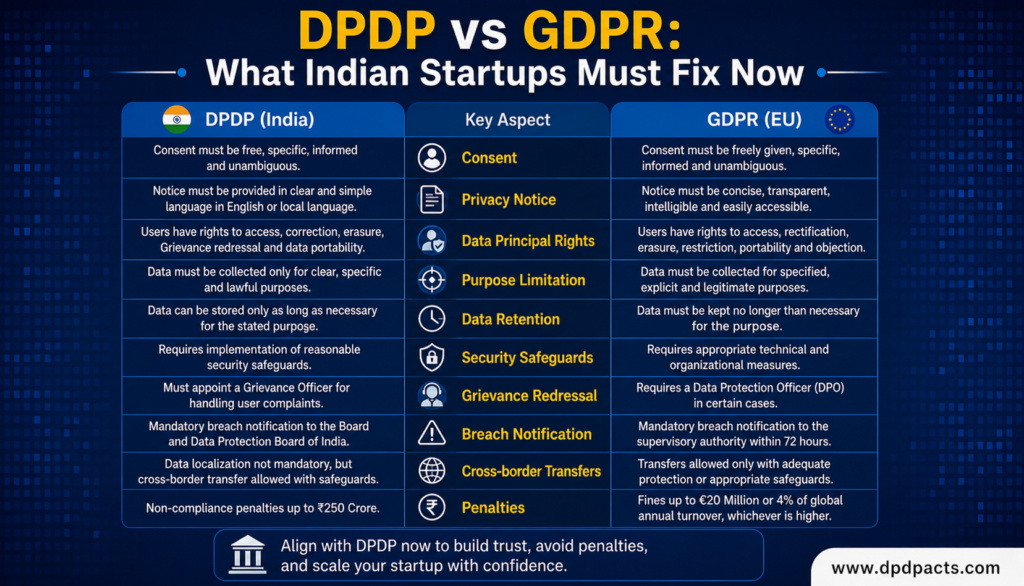
DPDP vs GDPR: What Indian Startups Must Fix Now

- Loading...
India’s Digital Personal Data Protection (DPDP) Act marks a decisive shift in how startups must think about user data. For years, many Indian companies aligned themselves with the EU’s GDPR standards, assuming that compliance with one global benchmark would be enough. That assumption no longer holds.
Get a callback
Even if your startup is GDPR-compliant, there are critical DPDP-specific gaps that require immediate attention. With penalties reaching up to ₹250 crore per violation, this is not a “wait and watch” moment—it’s a “fix it now” mandate.
Why Is DPDP Not Just “India’s GDPR”?
At a glance, both laws aim to protect user data and enforce accountability. But the philosophy and execution differ in ways that directly impact product design, legal frameworks, and engineering systems.
DPDP is consent-driven, simplified in structure, and stricter in certain areas, especially around children’s data and enforcement.
Key Differences: DPDP vs GDPR
- Consent Takes Center Stage
Under DPDP, consent is the primary legal basis for data processing. It must be:
- Explicit
- Granular
- Verifiable
GDPR, on the other hand, allows broader legal bases like “legitimate interest,” which startups often rely on for analytics, personalization, or marketing.
What this means:
If your product depends on inferred or bundled consent, you’re likely non-compliant under DPDP.
- Stricter Rules for Children’s Data
- DPDP defines children as under 18
- GDPR allows member states to lower this to 13–16
- DPDP prohibits tracking, behavioral monitoring, and targeted advertising for children
What this means:
Any startup with user-generated content, social features, or ad targeting must implement robust age-gating mechanisms.
- No “Sensitive Personal Data” Category
GDPR distinguishes between general and sensitive data (health, financial, biometric, etc.), with stricter rules for the latter.
DPDP eliminates this distinction—all personal data is treated equally.
What this means:
You cannot apply relaxed standards to “non-sensitive” data. Everything requires the same level of protection.
- Penalty Structure Is Fixed and Severe
- DPDP: Fixed penalties per violation (up to ₹250 crore)
- GDPR: Percentage-based (up to 4% of global turnover)
What this means:
Even smaller startups face massive financial risk, regardless of revenue scale.
- Data Subject Rights Are Simpler—but Narrower
DPDP provides:
- Right to access
- Right to correction
- Right to erasure
But it does not explicitly include the right to data portability, which GDPR mandates.
What this means:
While implementation may be simpler, startups must still build efficient mechanisms for deletion and access.
Critical Fixes Indian Startups Must Make Now
- Rebuild Your Consent Architecture
Most startups currently rely on:
- Pre-checked boxes
- Blanket “accept all” consent
- Bundled permissions
Under DPDP, this is insufficient.
Fix:
- Separate consent by purpose (marketing, analytics, personalization)
- Log and store consent records
- Ensure consent can be audited
- Make Withdrawal of Consent Frictionless
DPDP mandates that withdrawing consent should be as easy as giving it.
Fix:
- Add one-click withdrawal options
- Ensure backend systems stop processing immediately
- Trigger automated workflows for data deletion
- Build Automated Data Deletion Systems
Manual deletion processes won’t scale—and won’t comply.
Fix:
- Implement lifecycle-based deletion
- Auto-delete data when:
- Consent is withdrawn
- Purpose is fulfilled
- Ensure deletion cascades across third-party systems
- Appoint a Data Protection Officer (If Required)
If classified as a Significant Data Fiduciary, you must:
- Appoint a resident Data Protection Officer (DPO)
- Establish grievance redressal mechanisms
Fix:
- Assess whether your startup qualifies
- Prepare governance structures early
- Implement Strong Age-Gating Mechanisms
Simple “Are you 18+?” checkboxes are not enough.
Fix:
- Use verifiable age checks (OTP-based, ID-based, or third-party verification)
- Block tracking and profiling for minors
- Adjust UX for child-safe environments
- Strengthen Security and Breach Reporting
DPDP requires mandatory breach reporting to authorities.
Fix:
- Encrypt sensitive data in transit and at rest
- Implement role-based access controls
- Build breach detection and reporting workflows
- Audit Third-Party Data Processors
You are accountable for your vendors.
Fix:
- Review contracts with SaaS providers, analytics tools, and cloud services
- Ensure they meet DPDP obligations
- Add indemnity and compliance clauses
- Map Your Data Flows Thoroughly
You cannot protect what you don’t understand.
Fix:
- Document:
- What data you collect
- Why you collect it
- Where it is stored
- Who has access
- Update records regularly
Common Mistake: “We’re GDPR-Compliant, So We’re Safe”
This is the biggest misconception.
GDPR compliance helps—but it doesn’t cover:
- India-specific consent requirements
- Stricter child data rules
- Fixed penalty exposure
- Simplified but rigid compliance expectations
Startups that ignore these differences risk regulatory shock when enforcement tightens.
Timeline: Why You Should Act Now
Although DPDP rules are being rolled out in phases, enforcement is expected to tighten by late 2026 to mid-2027.
Delaying action means:
- Higher compliance costs later
- Product redesign under pressure
- Legal and reputational risks
Early movers gain an advantage by building privacy-first systems from the ground up.
Final Thoughts
DPDP is not just a legal requirement—it’s a product and trust transformation.
Startups that treat privacy as a core feature—not a compliance checkbox—will:
- Build stronger user trust
- Avoid regulatory penalties
- Gain a competitive edge
The question is no longer “Do we need to comply?”
It’s “How fast can we adapt?”
FAQs
Q1. Is GDPR compliance enough for DPDP?
A1. No. GDPR compliance helps, but DPDP has unique requirements—especially around consent, children’s data, and penalties.
Q2. Who qualifies as a Significant Data Fiduciary?
A2. The government will notify this based on factors like data volume, sensitivity, and risk. Such entities must appoint a DPO.
Q3. Can startups track or target ads to children?
A3. No. DPDP strictly prohibits tracking, profiling, or targeted advertising for minors.
Q4. What happens when a user withdraws consent?
A4. You must stop processing their data and delete it unless legally required to retain it.
Q5. Does DPDP require data localization?
A5. The Act allows cross-border transfers to approved countries, but rules may evolve.