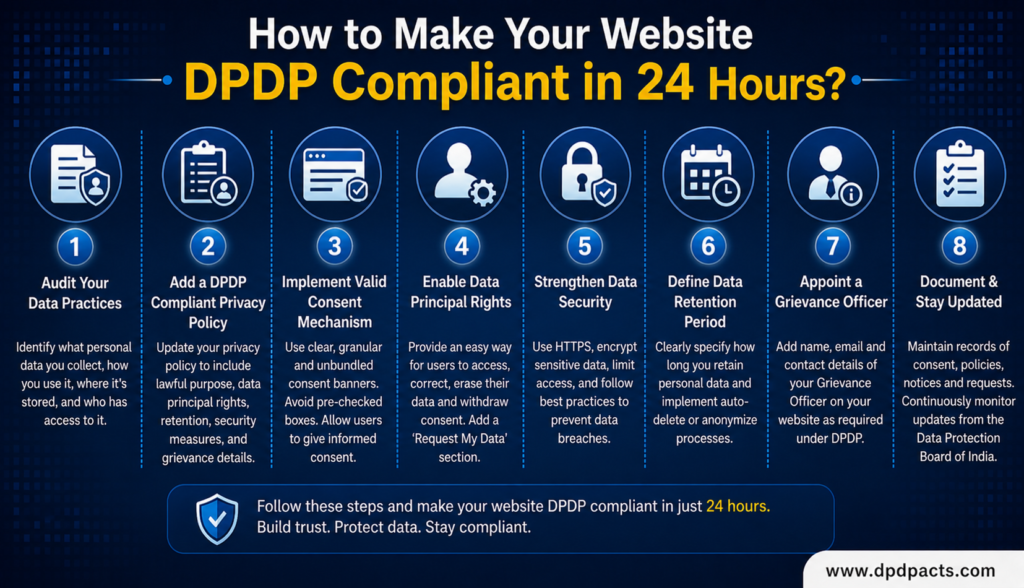
How to Make Your Website DPDP Compliant in 24 Hours?

- Loading...
The Digital Personal Data Protection (DPDP) Act is not just another regulation you can postpone or ignore—it represents a fundamental shift in how websites in India are expected to handle user data. At its core, it asks a simple but important question: are you being honest and respectful with the data people share with you? For most websites, the answer is not entirely clear. This isn’t usually due to bad intent, but rather the result of gradual changes over time. New tools get added, forms become longer, tracking scripts accumulate, and before you know it, transparency takes a back seat. DPDP compliance is about restoring that clarity. It pushes you to be open about what data you collect, explain why you collect it, and most importantly, give users real control over their personal information.
Get a callback
Can You Actually Make Your Website DPDP Compliant in 24 Hours?
Let’s set expectations straight—you’re not going to build a perfect compliance system overnight. However, you can absolutely fix the most visible and high-risk gaps in just a single day. Think about it from a user’s perspective: if someone lands on your website tomorrow, will they clearly understand what’s happening with their data, and will they feel in control of it? If the answer becomes “yes” within 24 hours, that’s already significant progress. This approach isn’t about achieving perfection instantly—it’s about building momentum and moving in the right direction quickly.
Where Is Your Website Collecting Data Without You Realizing It?
This is where most people get surprised. You might assume your website only collects data when a user fills out a contact form or signs up for a service, but in reality, data collection often begins the moment someone lands on your site. Analytics tools quietly track behavior, cookies store unique identifiers, chat widgets may log conversations, and even basic hosting services can record IP addresses and device information. When you step back and look at it honestly, your website isn’t just collecting data occasionally—it is constantly processing it in the background. The important part is that if users are not clearly aware of this, it creates a serious transparency and compliance gap. Taking just a few hours to map out this entire data flow can completely change your perspective. It gives you clarity on what is happening behind the scenes, and once that visibility is in place, improving compliance and making better decisions becomes much easier and more structured.
Are You Collecting More Data Than You Actually Need?
This is one of the easiest problems to fix, and at the same time, one of the most impactful. Many websites end up collecting extra information simply because they can, not because they actually need it. A contact form might ask for a phone number “just in case,” or a signup page may include multiple fields that don’t really serve a clear purpose. Under the DPDP framework, this kind of unnecessary data collection doesn’t hold up well anymore. The smarter approach is to simplify everything and focus only on what is genuinely required. If an email address is enough to serve the purpose, then there is no need to ask for additional details. What’s interesting is that this shift doesn’t just improve compliance—it also improves user experience. People are far more likely to engage with a website that feels respectful of their time, avoids unnecessary questions, and treats their privacy as something important rather than optional.
Does Your Website Feel Transparent to a First-Time Visitor?
Imagine visiting your own website for the first time and seeing it with fresh eyes. Would you immediately understand what happens to your data, or would you find yourself scrolling through long pages of legal text trying to make sense of it? This is exactly where your privacy policy becomes more than just a mandatory document—it becomes a direct reflection of your brand’s values. A good privacy policy doesn’t hide behind complexity or heavy legal language; instead, it communicates in a way that feels natural, clear, and easy to understand. It answers real questions in simple terms so that users don’t feel lost or overwhelmed. When someone reads it, the goal is not confusion but clarity—they should walk away feeling informed and confident about how their data is being used. That shift, from traditional legal writing to more human, transparent communication, is what truly makes a privacy policy effective under the DPDP framework.
Is Your Consent Mechanism Actually Meaningful?
Consent is one of the most important changes introduced by the DPDP Act because it fundamentally shifts control back to the user. For a long time, many websites operated on passive consent, where simply using the site was treated as agreement to everything in the background. That assumption no longer works in today’s privacy-focused environment. Now, consent has to be intentional and clearly given, meaning users must actively decide whether they want to share their data or allow tracking. More importantly, this decision should feel genuine and free, not influenced by confusing layouts or hidden design choices. If a website still relies on pre-ticked checkboxes or vague cookie banners, it is essentially missing the point of modern data protection. When users feel that they truly have control over their information, it changes their perception of the brand. They begin to trust the website more, and that trust naturally leads to stronger engagement and long-term user relationships.
What Does Your Cookie Banner Say About Your Website?
It might seem like a small detail, but your cookie banner is often the very first interaction a user has with your website, and that means it quietly sets the tone for everything that follows. First impressions matter more than most people realize. A confusing, aggressive, or overly pushy banner can make users uncomfortable within seconds, creating doubt before they even explore your content. On the other hand, a clear, calm, and respectful banner immediately builds a sense of trust. Instead of filling it with technical jargon or long legal explanations, the focus should be on simplicity and honesty—tell users what cookies are being used, why they are needed, and what benefit they provide. More importantly, give them real choices and let them decide for themselves without pressure. And once they make that choice, it must be respected consistently. Because the moment a website ignores or overrides user preferences, the entire idea of meaningful consent breaks down.
How Secure Is Your Website Right Now?
Security doesn’t need to be complicated to be effective. At the very least, your website should use HTTPS, which ensures that any data exchanged between the user and your site is encrypted and protected from interception. This is the basic layer of trust that every modern website is expected to have. Beyond that, it’s important to pause and think about where your data actually lives once it is collected. Is it being stored in a secure environment, and who has access to it within your team or through third-party tools you use? Many websites unknowingly share data across multiple services without fully understanding the chain of access. You don’t need to solve every security concern in a single day, but you do need to have clarity about what is happening behind the scenes. Because ultimately, collecting user data is not just about using it for business—it also comes with the responsibility of protecting it properly.
If a User Asked for Their Data, Could You Respond?
This is a question many website owners don’t really think about—until it becomes urgent. Under the DPDP framework, users are not just passive data providers; they have clear rights over their personal information. They can request to see what data you have collected, ask for corrections if something is wrong, or even demand deletion of their data entirely. Now imagine a real scenario where someone sends you such a request today—would you immediately know how to handle it, or would you feel unprepared? This is exactly where having a grievance contact or point of communication becomes important. It gives users a direct and transparent way to reach you, while also giving your business a structured process to respond instead of handling things in an ad-hoc manner. The good part is that it doesn’t need to be complicated or heavily technical—it simply needs to exist and be accessible. And surprisingly, even this basic level of clarity already puts you ahead of a large number of websites that haven’t thought about it yet.
What Happens If Something Goes Wrong?
No system is perfect, and mistakes or even data breaches can happen to any website, regardless of size or preparation. The real question is not whether something will go wrong, but whether you are ready to respond when it does. You don’t need a complex crisis management framework in place immediately, but you should at least have a basic, clear plan in mind. It should be simple enough that you know who takes responsibility, how an issue will be identified, and what the first few steps of action will look like. In situations involving sensitive user data, confusion often causes more damage than the incident itself. That’s why clarity matters so much—because when things go wrong, having a predefined direction helps you act faster, reduce risk, and protect both your users and your business.
Why Does DPDP Compliance Actually Help Your Business?
It’s easy to see compliance as just another burden—another rule to follow, another task to complete, another requirement added to an already long list. But there is another way to look at it. Most websites still handle user data casually, without much clarity or transparency, and that gap actually creates an opportunity for those who do it differently. When your website is clear about what it collects, respectful in how it asks for information, and transparent about how data is used, users immediately notice the difference. They feel more comfortable interacting with your platform and more willing to share information because they sense that their privacy is being taken seriously. Over time, this doesn’t just satisfy legal expectations—it builds something far more valuable. Trust. And in the digital world, trust is not just a compliance benefit, it is a real competitive advantage that directly influences user engagement and long-term growth.
What Can You Realistically Achieve in 24 Hours?
By the end of a focused day, your website can feel noticeably different in the way it communicates and handles user data. It becomes clearer in its intent, simpler in its structure, and more honest in the way it presents information to users. Instead of confusion or uncertainty, users can better understand what is happening with their data, why it is being collected, and how it is being used. They are also able to make real, informed choices rather than passive or unclear ones, and they know exactly where to go if they have concerns or questions. While this may not represent full legal compliance in every technical sense, it is still a strong and meaningful foundation. In fact, achieving this level of clarity and transparency is often the hardest part—and once that foundation is in place, everything that follows becomes significantly easier to build and improve.
Frequently Asked Questions (FAQs)
Q1. Is it really possible to achieve DPDP compliance in 24 hours?
A1. You can cover the most critical areas like consent, privacy policy, and security basics in a day. Full compliance, however, requires ongoing effort.
Q2. What is the biggest compliance gap on most websites?
A2. Most websites fail to take clear and active user consent. They rely on vague or implied consent, which is not valid anymore.
Q3. Do I need a lawyer to get started?
A3. No, you can begin with simple and transparent updates yourself. Legal review can come later for deeper compliance.
Q4. Is a cookie banner mandatory?
A4. Yes, if your website uses cookies or tracking tools. It must clearly ask for user permission before collecting data.
Q5. What is data minimization?
Q5. It means collecting only the data you actually need. Avoid asking for extra information without a clear purpose.
Q6. How do users withdraw consent?
A6. Users should have an easy option like a privacy settings link. It should be simple and accessible anytime.
Q7. Is HTTPS necessary?
A7. Yes, HTTPS ensures secure data transfer between users and your website. It is a basic requirement for data protection.
Q8. What is a grievance officer?
A8. It is a person responsible for handling user data requests and complaints. Their contact details must be available on your website.
Q9. Will compliance affect conversions?
A9. It may reduce some data collection, but it builds trust. Trusted users are more likely to engage long-term.
Q10. What should I do after implementing these steps?
A10. You should work on deeper compliance like audits and internal processes. Compliance is an ongoing journey, not a one-time task.