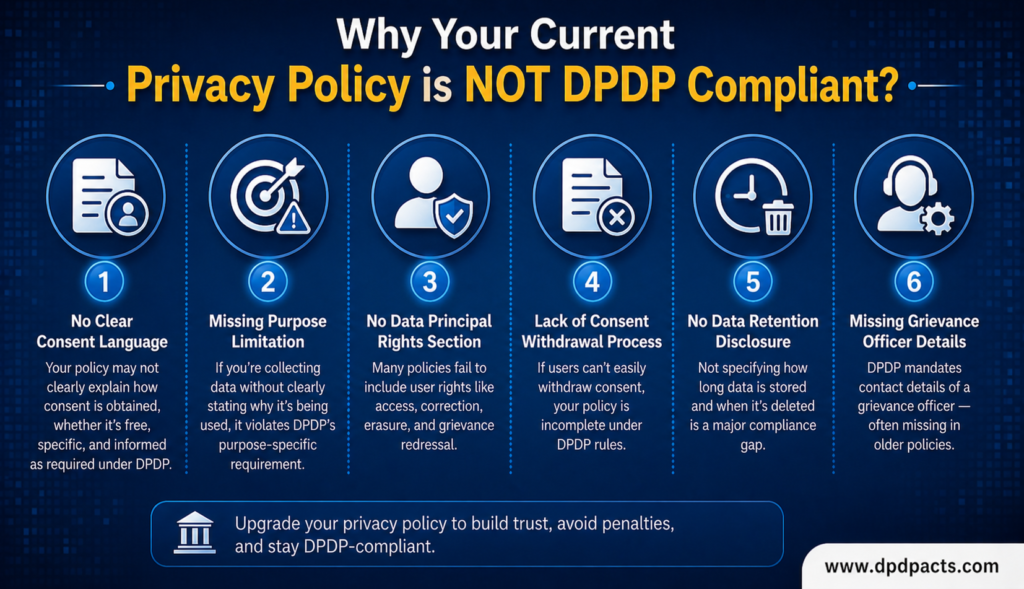
Why Your Current Privacy Policy is not DPDP Compliant

- Loading...
India’s data protection landscape has undergone a major shift with the introduction of the Digital Personal Data Protection Act, 2023 (DPDP Act) and the accompanying DPDP Rules 2025. These changes mark a clear departure from the older, more flexible frameworks that many organizations relied upon for years. If your current privacy policy was drafted under earlier guidelines—such as IT Rules 2011 or general GDPR-inspired templates—it is very likely outdated and non-compliant today.
Get a callback
The biggest transformation lies in moving from a passive “notice and choice” model to an active, user-centric “informed consent” regime. This shift demands precision, transparency, accessibility, and accountability from organizations (called “Data Fiduciaries” under the Act). Below is a detailed breakdown of why your existing privacy policy may fail under the DPDP framework—and what that means for your business.
1. Lack of Specificity and Purpose Limitation
One of the most critical principles under the DPDP Act is purpose limitation. Organizations must clearly define why they are collecting personal data and ensure it is used only for those stated purposes.
The Old Approach:
Most legacy privacy policies use broad, vague language like:
- “We may use your data to improve services”
- “We may use data for marketing purposes”
Why This Fails Now:
Under DPDP, such blanket statements are not acceptable. You must:
- Clearly list each type of personal data collected (e.g., email, phone number, location)
- Define specific purposes for each data type (e.g., “email for account verification,” “phone number for OTP authentication”)
What Needs to Change:
Your policy must be granular and itemized. For example:
- Instead of “we use data for marketing,” specify:
- “We use your email address to send promotional offers related to products you have previously purchased.”
This level of detail ensures users know exactly what they are consenting to.
2. Failure to Provide Itemized and Timely Notice
The DPDP Act mandates that notice must be provided at or before the time of data collection, not buried in legal documents.
The Old Approach:
- Privacy policies hidden inside Terms & Conditions
- Users forced to accept everything in one click
Why This Fails Now:
DPDP requires:
- Standalone, prominent notices
- Clear explanation of:
- What data is collected
- Why it is collected
- How users can withdraw consent
What Needs to Change:
- Use layered notices (short summary + detailed policy)
- Display consent prompts at the exact moment of data collection
- Avoid pre-ticked checkboxes or bundled consent
3. Lack of Multilingual Accessibility
India is linguistically diverse, and the DPDP Act reflects this reality.
Requirement:
Privacy notices must be available in:
- English and
- At least one of the 22 languages listed in the Constitution’s Eighth Schedule
Why This Matters:
If your policy is only in English, you are excluding a significant portion of users from truly understanding their rights.
What Needs to Change:
- Provide translations in commonly used languages (e.g., Hindi, Tamil, Bengali)
- Ensure translations are accurate and legally consistent
This is not just compliance—it’s about inclusivity and fairness.
4. Inadequate Consent Withdrawal Mechanisms
Consent under DPDP must be:
- Freely given
- Specific
- Informed
- Easily withdrawable
The Old Approach:
- Complicated opt-out processes
- Hidden unsubscribe links
- Manual email requests for data deletion
Why This Fails Now:
The law explicitly states:
Withdrawal of consent must be as easy as giving it.
What Needs to Change:
- One-click unsubscribe options
- User dashboards to manage data preferences
- Simple “Delete My Data” requests
If users struggle to withdraw consent, you are non-compliant.
5. Missing Data Protection Officer (DPO) or Grievance Officer Details
Transparency and accountability are central to the DPDP framework.
Requirement:
Every Data Fiduciary must:
- Appoint a Grievance Officer
- Provide clear contact details
Significant Data Fiduciaries may also need a Data Protection Officer (DPO).
Why This Fails:
Many existing policies:
- Provide generic contact forms
- Lack dedicated grievance channels
What Needs to Change:
- Include:
- Name/designation
- Email/contact details
- Response timelines
- Ensure users can easily raise complaints
6. Failure to Address Children’s Data Protection
The DPDP Act introduces strict safeguards for minors (under 18).
Key Requirements:
- Verifiable parental consent is mandatory
- No behavioral tracking or targeted advertising to children
The Old Approach:
Most policies:
- Treat all users equally
- Do not distinguish minors
Why This Fails:
This is a serious compliance gap with potentially high penalties.
What Needs to Change:
- Age verification mechanisms
- Parental consent workflows
- Separate privacy disclosures for children
Ignoring this area can lead to severe legal consequences.
7. Absence of Defined Data Retention Timelines
Another major requirement is data minimization and storage limitation.
The Old Approach:
- “We retain data as long as necessary”
Why This Fails:
This phrase is too vague and does not meet DPDP standards.
What Needs to Change:
- Define retention periods for each purpose:
- “We retain your account data for 12 months after account closure”
- “Transaction records are retained for 8 years for legal compliance”
- Automatically delete data once the purpose is fulfilled
8. Weak Transparency Around Data Sharing
DPDP requires clarity on whether data is shared with third parties.
The Problem:
Older policies often:
- Mention “trusted partners” without naming them
- Do not specify categories of recipients
What Needs to Change:
- Clearly identify:
- Third-party service providers
- Categories (payment processors, analytics providers, etc.)
- Explain why data is shared
9. Lack of User Rights Communication
Under the DPDP Act, users (Data Principals) have rights such as:
- Right to access information
- Right to correction
- Right to erasure
- Right to grievance redressal
Why This Fails:
Many policies either:
- Don’t mention these rights
- Or mention them vaguely
What Needs to Change:
- Clearly list all user rights
- Provide step-by-step instructions to exercise them
10. No Preparedness for Data Breach Notification
The DPDP framework emphasizes accountability in case of breaches.
Requirement:
- Notify authorities and affected users in case of data breaches
Why This Fails:
Older policies rarely include breach protocols.
What Needs to Change:
- Define breach response procedures
- Commit to timely notifications
Why This Matters: Penalties and Business Impact
Non-compliance with the Digital Personal Data Protection Act, 2023 is not just a legal risk—it’s a financial and reputational one.
Potential penalties include:
- Up to ₹50 crore per instance for violations
- Up to ₹250 crore for failure to prevent data breaches
Beyond fines:
- Loss of customer trust
- Brand damage
- Regulatory scrutiny
Compliance is no longer optional—it is a core business requirement.
Conclusion
The DPDP Act represents a fundamental shift in how personal data must be handled in India. It demands clarity, fairness, and accountability at every stage of data processing. If your privacy policy still relies on vague language, bundled consent, or outdated practices, it is almost certainly non-compliant.
Updating your policy is not just about avoiding penalties—it’s about building trust with your users in a privacy-conscious digital world.
Frequently Asked Questions (FAQs)
Q1. What is the DPDP Act?
A1. The Digital Personal Data Protection Act, 2023 is India’s primary legislation governing how personal data is collected, processed, and stored.
Q2. Who does the DPDP Act apply to?
A2. It applies to any individual or organization processing digital personal data in India, including businesses, startups, and government entities.
Q3. What is “informed consent” under DPDP?
A3. It means users must clearly understand what data is collected, why, and how it will be used before agreeing.