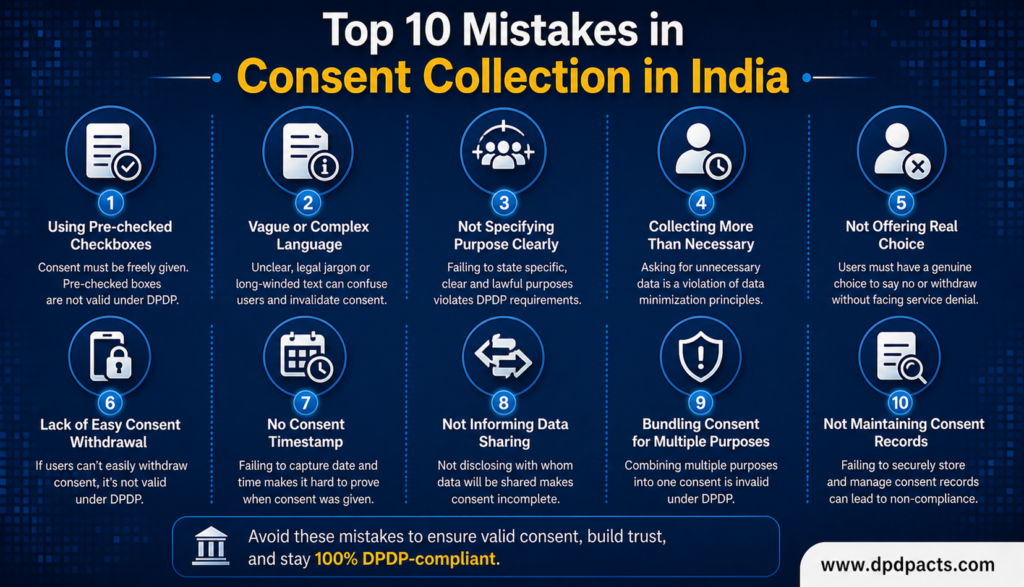
Top 10 Mistakes in Consent Collection in India

- Loading...
India’s Digital Personal Data Protection (DPDP) Act has fundamentally changed how organizations collect, process, and manage personal data. Consent is now at the heart of compliance, and businesses—whether start-ups, SaaS companies, or large enterprises—must ensure their consent mechanisms meet strict legal standards.
Get a callback
Under the DPDP framework, consent must be free, specific, informed, unconditional, and given through clear affirmative action. However, many organizations still rely on outdated or non-compliant practices, exposing themselves to regulatory penalties, reputational damage, and loss of user trust.
This detailed guide explores the top 10 mistakes in consent collection in India, why they matter, and how to fix them.
What Makes Consent Valid Under DPDP?
Before understanding mistakes, it’s important to understand what valid consent looks like:
- Free: No coercion or forced agreement
- Specific: Clearly tied to a defined purpose
- Informed: Users understand what they are agreeing to
- Unconditional: Not bundled with unrelated terms
- Affirmative: Requires a clear action (e.g., clicking “Accept”)
Failing to meet any of these conditions can make consent invalid.
1. Pre-Checked Boxes and Forced Consent
One of the most common violations is using pre-ticked checkboxes or forcing users to accept data collection as a condition for accessing a service.
Why It’s a Problem:
- Violates the principle of free and affirmative consent
- Users are not actively choosing to opt in
Example:
A sign-up form where marketing emails are enabled by default.
Fix:
- Use unchecked boxes
- Allow users to actively opt in
2. Bundling Consent with Terms & Conditions
Many companies combine consent for data processing with acceptance of general terms of service.
Why It’s a Problem:
- Consent must be separate and purpose-specific
- Users cannot meaningfully choose what they agree to
Fix:
- Provide separate consent checkboxes for:
- Terms of service
- Marketing communications
- Data sharing with third parties
3. No “Reject All” Option in Cookie Banners
Cookie banners that only provide an “Accept All” button without an equally visible “Reject All” option are non-compliant.
Why It’s a Problem:
- Consent must be freely given, not nudged
- Dark patterns are discouraged under DPDP
Fix:
- Add a clear “Reject All” button
- Ensure equal visibility and ease of use
4. No Clear Record of Consent or Revocation
Organizations often fail to maintain proper logs of user consent.
Why It’s a Problem:
- You must demonstrate compliance if audited
- Lack of records can lead to penalties
Fix:
Maintain logs that include:
- User ID
- Timestamp
- Purpose of consent
- Method of collection
- Withdrawal records
5. Vague or One-Size-Fits-All Notices
Using generic privacy notices filled with legal jargon is a major mistake.
Why It’s a Problem:
- Users cannot make informed decisions
- Violates transparency requirements
Example:
“We may use your data to improve services” (too vague)
Fix:
- Clearly define:
- What data is collected
- Why it is collected
- How it will be used
6. Making Consent Withdrawal Difficult
If users have to email support or navigate complex settings to withdraw consent, it’s a violation.
Why It’s a Problem:
- Withdrawal must be as easy as giving consent
Fix:
- Provide:
- One-click unsubscribe links
- Easy privacy dashboards
- Simple toggle settings
7. Treating Privacy Policy as Consent
Some organizations assume that simply linking a privacy policy equals user consent.
Why It’s a Problem:
- Passive actions (like browsing) do not count as consent
- Consent requires explicit action
Fix:
- Use clear prompts like:
- “I agree to the collection and use of my data”
8. Not Updating Consent for New Technologies
Introducing new tracking tools, analytics systems, or AI tools without updating consent is risky.
Why It’s a Problem:
- Consent must be purpose-specific
- New tools = new purposes
Fix:
- Re-consent users when:
- Adding new cookies or trackers
- Changing data usage practices
9. Lack of Multilingual Notices
India is linguistically diverse, and the DPDP Act emphasizes understandable communication.
Why It’s a Problem:
- Users may not fully understand consent requests
- Can invalidate “informed consent”
Fix:
- Offer notices in:
- English
- Hindi
- Regional languages (where relevant)
10. Ignoring Data Subject Rights
Even after consent is withdrawn, some organizations continue processing data or ignore user requests.
Why It’s a Problem:
- Violates core user rights under DPDP:
- Access
- Correction
- Erasure
Fix:
- Build systems to:
- Process user requests quickly
- Stop data processing upon withdrawal
Best Practices for DPDP Compliance
To avoid these mistakes, organizations should:
- Implement granular consent mechanisms
- Maintain audit-ready consent logs
- Use plain, user-friendly language
- Provide easy withdrawal options
- Regularly review and update consent flows
Why Consent Compliance Matters
Ignoring DPDP requirements can lead to:
- Heavy financial penalties
- Loss of customer trust
- Legal action
- Brand damage
On the other hand, strong consent practices:
- Build transparency
- Improve user trust
- Enhance brand reputation
Final Thoughts
The DPDP Act marks a significant shift toward user-first data governance in India. Consent is no longer a checkbox formality—it is a legal and ethical obligation.
By avoiding these common mistakes and adopting transparent, user-friendly practices, businesses can not only stay compliant but also build long-term trust with their users.
If your organization hasn’t audited its consent mechanisms yet, now is the time.
Frequently Asked Questions (FAQs)
Q1. What is valid consent under the DPDP Act?
Q1. Valid consent must be free, specific, informed, unconditional, and given through clear affirmative action.
Q2. Are pre-checked boxes allowed in India?
A2. No, pre-checked boxes are not allowed as they do not represent active user consent.
Q3. Is a privacy policy enough to collect consent?
A3. No, a privacy policy alone is not sufficient. Consent requires explicit user action.
Q4. Do I need a “Reject All” option in cookie banners?
A4. Yes, users must have an equally accessible option to reject all non-essential cookies.
Q5. How should users withdraw consent?
A5. Users must be able to withdraw consent easily, ideally with a single click or simple interface.