Personal Data under DPDP Act

Listen to This Article
The Digital Personal Data Protection Act, 2023 (DPDP Act) marks a major step in India’s journey toward strengthening privacy rights in the digital age. As digital ecosystems expand and individuals increasingly share personal information online, the need for a robust legal framework to safeguard data has become critical. Introduced by the Ministry of Electronics and Information Technology, the Act establishes clear rules around how personal data is collected, processed, stored, and protected.
Get a callback
At the heart of the DPDP Act lies the concept of personal data. Understanding what qualifies as personal data—and how it is regulated—is essential for individuals, businesses, and policymakers alike. This blog explores the definition, scope, key principles, obligations, and implications of personal data under the Act.
What is Personal Data?
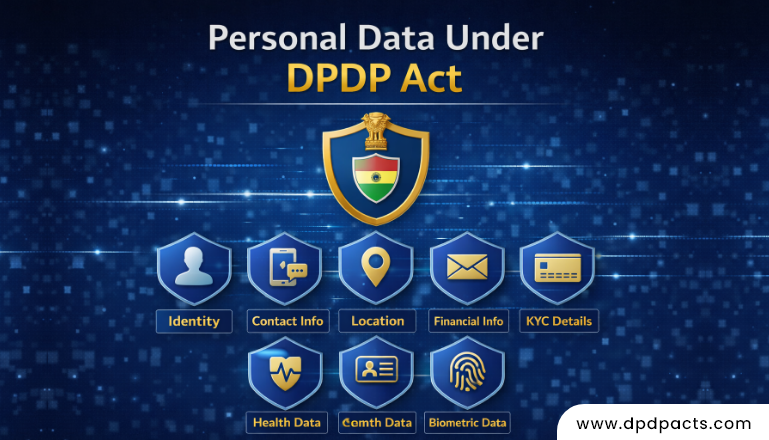
Under the DPDP Act, personal data is defined as any data about an individual who is identifiable by or in relation to such data. This is a broad and inclusive definition, ensuring that both direct and indirect identifiers are covered.
Key Elements of Personal Data
1. Identifiability
Data qualifies as personal data if it can identify an individual either directly or indirectly. Examples include:
- Name
- Address
- Phone number
- Email ID
- Financial or payment information
- Biometric data
- Location data
- Social media activity
Even if a single piece of information does not identify someone on its own, it may still be considered personal data when combined with other data points.
2. Data “in relation to” an Individual
The Act extends beyond obvious identifiers. It includes data that is related to an individual, such as:
- Behavioral patterns (e.g., browsing history)
- Preferences (e.g., shopping habits)
- Profiles created through analytics
- Predictive or inference-based data
This ensures modern data practices like profiling and targeted advertising fall within the regulatory scope.
3. Exclusion of Non-Personal Data
Data that does not identify an individual is not considered personal data. Examples include:
- Aggregated statistics
- Anonymized datasets
- General market trends
However, if anonymized data can be re-identified, it may still fall under the Act.
4. Publicly Available Data
The Act provides nuanced treatment of public data:
- Data voluntarily made public by individuals may still be protected.
- Data published by government authorities or under legal obligations may be exempt in certain cases.
Types of Data Covered
- Digital Personal Data
The DPDP Act primarily focuses on digital data, including:
- Data collected online (websites, apps, social media)
- Data collected offline but later digitized
This ensures that traditional records converted into digital form are also regulated.
- Non-Digital Data
Purely physical records (e.g., paper files) are generally outside the scope unless:
- They are part of a structured filing system, or
- They are digitized later
This reflects the Act’s emphasis on digital ecosystems.
Key Roles Defined in the Act
To regulate data effectively, the DPDP Act defines three crucial roles:
- Data Principal
The individual whose personal data is being processed. Every citizen interacting with digital platforms is a data principal.
- Data Fiduciary
Any entity (individual, company, or government body) that determines:
- Why personal data is collected
- How it is processed
Examples include tech companies, banks, e-commerce platforms, and government agencies.
- Data Processor
An entity that processes personal data on behalf of a data fiduciary. For example:
- Cloud service providers
- IT outsourcing firms
Core Principles Governing Personal Data
The DPDP Act is built on several foundational principles that guide how personal data should be handled.
- Consent-Based Processing
Consent is the cornerstone of the Act. It must be:
- Free
- Specific
- Informed
- Unconditional
- Unambiguous
Users must clearly understand what they are agreeing to, and consent requests must be presented in simple language.
- Purpose Limitation
Data can only be used for the purpose for which it was collected. For example:
- If data is collected for account creation, it cannot be used for marketing without additional consent.
- Data Minimization
Organizations should collect only the minimum amount of data necessary. Excessive data collection is discouraged and may be penalized.
- Accuracy
Data fiduciaries must ensure that personal data is accurate and updated, especially when used for decision-making.
- Storage Limitation
Data should not be retained indefinitely. It must be deleted once the purpose is fulfilled.
- Security Safeguards
Organizations must implement appropriate measures to protect data from:
- Unauthorized access
- Breaches
- Loss or misuse
Rights of Individuals (Data Principals)
The DPDP Act empowers individuals with several important rights:
- Right to Access Information
Individuals can request details about:
- What data is collected
- How it is used
- Who it is shared with
- Right to Correction
If personal data is inaccurate or incomplete, individuals can request corrections.
- Right to Erasure
Individuals can ask for their data to be deleted when:
- It is no longer necessary
- Consent is withdrawn
- Right to Grievance Redressal
Users can raise complaints if their data is misused or their rights are violated.
- Right to Nominate
Individuals can nominate someone to exercise their rights in case of death or incapacity.
Obligations of Data Fiduciaries
Organizations handling personal data must comply with strict responsibilities:
- Obtain Valid Consent
Before collecting data, explicit consent must be taken.
- Provide Notice
Users must be informed about:
- What data is collected
- Purpose of collection
- Rights available to them
- Ensure Data Security
Implement safeguards such as:
- Encryption
- Access controls
- Regular audits
- Report Data Breaches
Any data breach must be reported to authorities and affected individuals.
- Delete Data When Not Needed
Data must be erased once its purpose is fulfilled or consent is withdrawn.
Penalties for Non-Compliance
The DPDP Act introduces stringent penalties to ensure compliance. Fines can go up to ₹250 crore per violation, depending on the severity of the breach.
Factors influencing penalties include:
- Nature of the breach
- Volume of data affected
- Whether negligence was involved
- Measures taken to mitigate harm
Impact of the DPDP Act
- For Individuals
- Greater control over personal data
- Increased transparency
- Better protection against misuse
- For Businesses
- Need to redesign data handling practices
- Increased compliance costs
- Greater accountability
- For the Digital Ecosystem
- Builds trust in digital services
- Encourages responsible data practices
- Aligns India with global data protection standards
Challenges and Considerations
While the DPDP Act is a significant step forward, implementation challenges remain:
- Awareness among users is still low
- Small businesses may struggle with compliance
- Enforcement mechanisms need strengthening
- Balancing innovation with regulation is complex
Conclusion
The DPDP Act, 2023, represents a landmark shift in how personal data is treated in India. By clearly defining personal data and establishing strong safeguards, the Act ensures that individuals retain control over their digital identities. At the same time, it places significant responsibility on organizations to handle data ethically and transparently.
As digital interactions continue to grow, understanding personal data and its protection will become increasingly important—not just for legal compliance, but for building a trustworthy digital future.
Frequently Asked Questions (FAQs)
Q1. What is personal data under the DPDP Act?
A1. Personal data is any information that can identify an individual directly or indirectly. It includes data like name, contact details, location, and online activity.
Q2. Does the Act apply to offline data?
A2. The Act mainly applies to digital personal data. Offline data is covered only if it is digitized or part of a structured filing system.
Q3. Who is a Data Principal?
A3. A Data Principal is the individual whose personal data is being processed. It refers to any person interacting with digital platforms or services.
Q4. What is a Data Fiduciary?
A4. A Data Fiduciary is an entity that decides why and how personal data is processed. This includes companies, government bodies, and organizations handling data.
Q5. Is consent always required?
A5. Yes, consent is essential for processing personal data under the Act. It must be free, informed, specific, and unambiguous unless exempted by law.
Q6. What rights do individuals have under the Act?
A6. Individuals have rights to access, correct, and erase their personal data. They can also file complaints and seek grievance redressal.
Q7. What happens in case of a data breach?
A7. Organizations must report data breaches to authorities and affected users. They may face penalties depending on the severity of the breach.
Q8. Are public data and social media posts covered?
A8. Yes, publicly shared data can still be protected under the Act. Protection depends on context and how the data is used.
Q9. What is data minimization?
A9. Data minimization means collecting only the data necessary for a specific purpose. It prevents excessive or unnecessary data collection by organizations.
Q10. What is the maximum penalty under the DPDP Act?
A10. The Act allows penalties up to ₹250 crore per violation. The amount depends on the nature and seriousness of the breach.