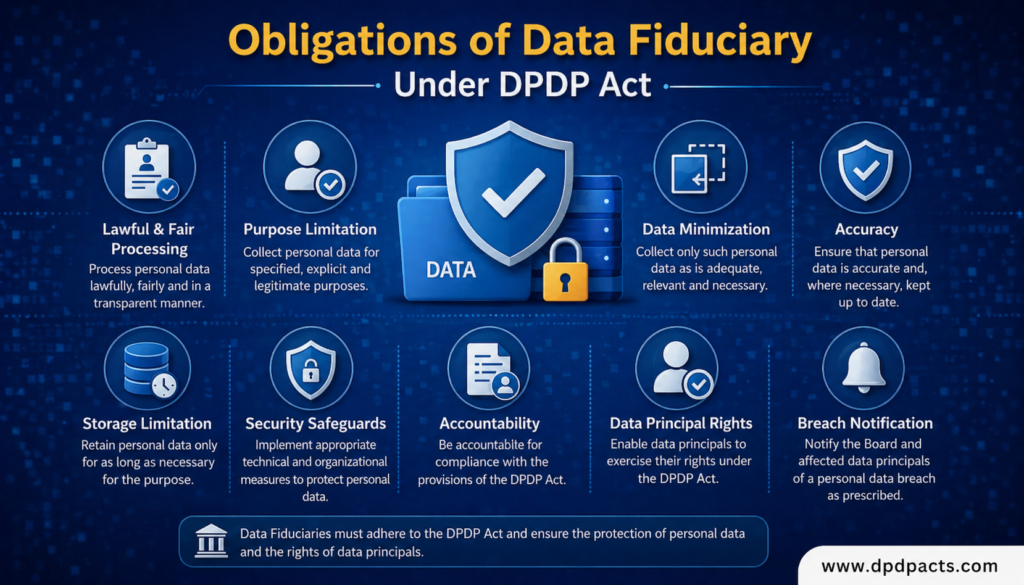
Obligations of Data Fiduciary Under DPDP Act

Listen to This Article
In today’s digital-first economy, personal data has become one of the most valuable assets for organizations. From e-commerce platforms and fintech startups to healthcare providers and HR systems, nearly every business processes personal data in some form. Recognizing the need to regulate this rapidly expanding data ecosystem, India introduced the Digital Personal Data Protection (DPDP) Act, 2023.
Get a callback
This legislation establishes a structured framework for how personal data should be collected, processed, stored, and protected. At the heart of this framework lies the concept of the Data Fiduciary—an entity entrusted with handling personal data responsibly.
But compliance is not just about avoiding penalties. It is about building trust, strengthening governance, and ensuring long-term sustainability in a data-driven world.
Understanding the Role of a Data Fiduciary
A Data Fiduciary is any individual, company, or organization that determines:
- The purpose of processing personal data
- The means by which such data is processed
In simple terms, if your organization decides why and how personal data is used, you are a Data Fiduciary.
Examples include:
- An e-commerce company collecting customer details
- A bank processing financial information
- A startup using analytics tools to track user behavior
Core Obligations of a Data Fiduciary
Let’s explore each obligation in detail and understand how it applies in real-world scenarios.
- Consent Management: The Cornerstone of Compliance
Consent is the foundation of lawful data processing under the DPDP Act.
A Data Fiduciary must obtain consent that is:
- Free: Given without coercion or undue influence
- Specific: Clearly linked to a defined purpose
- Informed: Users must know what they are agreeing to
- Unambiguous: No vague language or hidden clauses
- Affirmative: Requires clear action (e.g., ticking a box)
Practical Example:
If a mobile app collects location data, it must clearly state:
- Why the data is needed (e.g., delivery tracking)
- Whether it will be shared with third parties
Pre-ticked checkboxes or bundled consent (e.g., agreeing to terms AND marketing emails together) are not valid.
- Notice Requirements: Transparency is Non-Negotiable
Before collecting personal data, Data Fiduciaries must provide a clear and accessible notice.
This notice should include:
- Types of personal data being collected
- Purpose of processing
- Rights of the Data Principal
- Grievance redressal mechanisms
Best Practices:
- Use simple language (avoid legal jargon)
- Provide multilingual notices where relevant
- Ensure visibility at the point of data collection
Transparency not only ensures compliance but also builds user confidence.
- Ensuring Accuracy and Data Integrity
Data Fiduciaries are responsible for maintaining:
- Accuracy
- Completeness
- Consistency
This obligation is especially important in cases where decisions are made based on personal data, such as:
- Credit scoring
- Insurance underwriting
- Employment decisions
Risk of Non-Compliance:
Incorrect data can lead to:
- Financial losses
- Legal disputes
- Reputational damage
Organizations should implement processes for periodic data verification and correction.
- Data Retention Limitation: No More “Store Forever”
The DPDP Act emphasizes purpose limitation and data minimization.
Data Fiduciaries must:
- Retain personal data only as long as necessary
- Delete data once the purpose is fulfilled
- Delete data when consent is withdrawn
Example:
If a user deletes their account on an e-commerce platform, their personal data should not be retained indefinitely unless required by law.
This requires:
- Automated deletion policies
- Data lifecycle management systems
- Security Safeguards: Protecting Data from Breaches
One of the most critical obligations is implementing reasonable security safeguards.
These include:
Technical Measures:
- Encryption
- Multi-factor authentication
- Secure servers
- Access controls
Organizational Measures:
- Employee training
- Internal policies
- Risk assessments
- Vendor due diligence
The term “reasonable” depends on:
- Nature of data
- Volume of data
- Risk involved
- Personal Data Breach Notification
In the event of a data breach, the Data Fiduciary must:
- Notify the Data Protection Board of India
- Inform affected Data Principals
What counts as a breach?
- Unauthorized access
- Data leaks
- Accidental exposure
- Data theft
Key Requirement:
Notification must be prompt and transparent.
Delays can significantly increase regulatory penalties and reputational harm.
- Grievance Redressal Mechanism
The DPDP Act empowers individuals to raise concerns about their data.
Data Fiduciaries must:
- Appoint a Grievance Officer
- Provide clear contact details
- Respond within a reasonable time
Why this matters:
A strong grievance mechanism:
- Prevents escalation to regulators
- Enhances user trust
- Improves internal accountability
- Accountability for Data Processors
Many organizations rely on third-party vendors for:
- Cloud storage
- Payment processing
- Analytics
These vendors are known as Data Processors.
However, the responsibility remains with the Data Fiduciary.
Obligations include:
- Conducting vendor due diligence
- Signing compliant contracts
- Monitoring processor activities
Outsourcing does not reduce liability.
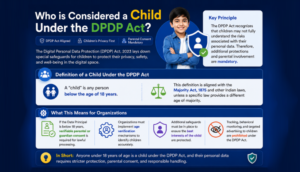
- Special Obligations for Children’s Data
Children’s data receives enhanced protection under the DPDP Act.
If processing data of individuals under 18:
- Obtain verifiable parental consent
- Avoid behavioral tracking
- Avoid targeted advertising
Practical Implication:
Apps and websites targeting minors must redesign their data practices to ensure compliance.
Significant Data Fiduciaries (SDFs): Higher Responsibility, Higher Scrutiny
The government may designate certain entities as Significant Data Fiduciaries based on:
- Volume of data processed
- Sensitivity of data
- Risk to national security or individuals
Additional Obligations Include:
- Appointment of Data Protection Officer (DPO)
- Must be based in India
- Acts as a compliance leader
- Data Protection Impact Assessment (DPIA)
- Identifies risks before data processing begins
- Independent Data Auditor
- Conducts unbiased compliance checks
- Periodic Audits
- Ensures ongoing compliance
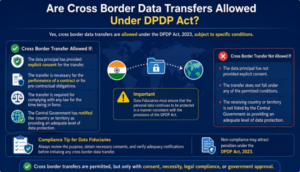
Data Localization and Cross-Border Transfers
The DPDP Act allows the government to:
- Restrict transfer of data to certain countries
- Impose localization requirements
While detailed rules may evolve, businesses should:
- Map data flows
- Prepare for localization scenarios
- Monitor regulatory updates
Building a Compliance Strategy: Practical Steps
To comply effectively, organizations should:
- Conduct a data audit
- Map data collection and processing activities
- Update privacy policies
- Implement consent management systems
- Strengthen cybersecurity measures
- Train employees
- Establish incident response plans
Why Compliance is a Strategic Advantage
Organizations that proactively comply with the DPDP Act can:
- Build stronger customer trust
- Improve operational efficiency
- Reduce legal risks
- Gain a competitive edge
In a world where users are increasingly aware of privacy rights, compliance is not just legal—it’s strategic.
Frequently Asked Questions (FAQs)
Q1. What is the main objective of the DPDP Act?
A1. To regulate the processing of digital personal data. It also aims to protect individual privacy rights.
Q2. Who is a Data Principal?
A2. A Data Principal is the individual whose personal data is being processed. They are the owner of their personal information.
Q3. Is consent always mandatory?
A3. Yes, consent is generally required before processing personal data. However, certain legal exemptions may apply.
Q4. Can users withdraw consent?
A4. Yes, users have the right to withdraw consent at any time. Once withdrawn, processing must stop.
Q5. What happens if a company fails to comply?
A5. Non-compliance can lead to heavy financial penalties. These penalties may run into crores of rupees.
Q6. Are startups covered under the DPDP Act?
A6. Yes, the Act applies to all entities regardless of size. Startups must comply if they process personal data.
Q7. What is a data breach?
A7. A data breach is any unauthorized access or disclosure of personal data. It also includes loss, alteration, or destruction of data.
Q8. Do all companies need a Data Protection Officer?
A8. No, only Significant Data Fiduciaries are required to appoint a DPO. Other companies are not mandated.
Q9. How long can personal data be stored?
A9. Data can be stored only as long as necessary for its purpose. It must be deleted after the purpose is fulfilled or consent is withdrawn.
Q10. What is the role of the Data Protection Board of India?
A10. It monitors compliance with the DPDP Act. It also handles complaints and imposes penalties.