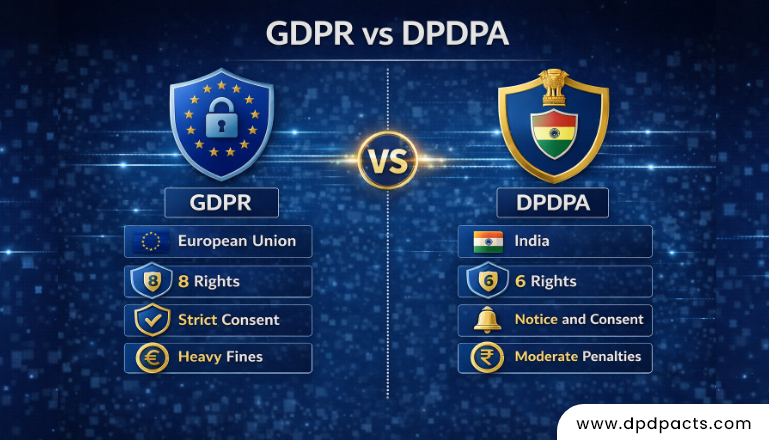
Difference Between GDPR and DPDPA

- Loading...
In an increasingly digital world, personal data has become one of the most valuable assets. Governments across the globe are enacting regulations to protect individuals’ privacy and ensure responsible data handling by organizations. Two prominent frameworks in this domain are the European Union’s General Data Protection Regulation (GDPR) and India’s Digital Personal Data Protection Act (DPDPA), 2023.
Get a callback
While both aim to safeguard personal data and establish accountability, they differ significantly in scope, structure, and enforcement rigor. This blog provides a detailed comparison of GDPR and DPDPA, examining their key features, differences, and implications for businesses and individuals.
Understanding GDPR and DPDPA
What is GDPR?
The General Data Protection Regulation (GDPR), enforced in May 2018, is one of the world’s most stringent data protection laws. It governs how organizations collect, process, store, and transfer personal data of individuals within the European Union (EU).
GDPR applies not only to EU-based organizations but also to entities worldwide that process the data of EU residents.
What is DPDPA 2023?
India’s Digital Personal Data Protection Act (DPDPA), enacted in 2023, is the country’s first comprehensive law focused specifically on digital personal data. It regulates how organizations process digital personal data of individuals within India.
Unlike GDPR, DPDPA is narrower in scope and focuses primarily on consent-driven data processing.
Key Differences Between GDPR and DPDPA
- Scope and Coverage
One of the most fundamental differences lies in the scope of data covered.
| Aspect | GDPR | DPDPA 2023 |
| Data Coverage | Covers both digital and offline personal data | Covers only digital personal data |
| Geographic Scope | Applies globally if EU residents’ data is processed | Applies to data processed within India |
| Extraterritorial Reach | Strong | Limited but applicable if offering services in India |
GDPR’s broad scope makes it more comprehensive, while DPDPA focuses specifically on the digital ecosystem.
- Data Subject Rights
GDPR provides a robust framework of individual rights, whereas DPDPA offers a more limited set.
| Rights | GDPR | DPDPA 2023 |
| Right to Access | Yes | Yes |
| Right to Correction | Yes | Yes |
| Right to Erasure | Yes | Yes |
| Right to Data Portability | Yes | No |
| Right to Object | Yes | Limited |
| Rights Against Automated Decision-Making | Yes | Not explicitly provided |
GDPR empowers users significantly more, especially in areas like automated decision-making and portability.
- Consent and Legal Basis
Consent plays a central role in both regulations, but GDPR allows more flexibility.
| Aspect | GDPR | DPDPA 2023 |
| Legal Bases | Multiple (consent, contract, legal obligation, legitimate interest) | Primarily consent + “legitimate use” |
| Consent Standard | Freely given, specific, informed, unambiguous | Clear and informed consent required |
| Withdrawal of Consent | Must be as easy as giving consent | Explicitly required |
DPDPA places a stronger emphasis on consent, while GDPR allows broader lawful processing options.
- Data Breach Notification
Data breach response requirements differ significantly.
| Aspect | GDPR | DPDPA 2023 |
| Notification Timeline | Within 72 hours | No specific timeline |
| Authority Reporting | Mandatory | Mandatory |
| User Notification | Required in high-risk cases | Required |
GDPR is stricter due to its clearly defined 72-hour reporting window.
- Children’s Data Protection
| Aspect | GDPR | DPDPA 2023 |
| Age Threshold | Typically 16 (varies by country) | Under 18 |
| Parental Consent | Required | Required |
| Additional Safeguards | Limited | Stronger focus on preventing harm |
DPDPA explicitly prohibits processing that could harm a child’s well-being, reflecting a protective stance.
- Government Exemptions
| Aspect | GDPR | DPDPA 2023 |
| Government Access | Limited and regulated | Broad exemptions allowed |
| Oversight | Independent authorities | Less independent oversight |
DPDPA has faced criticism for granting wider access to government agencies.
- Data Retention and Erasure
| Aspect | GDPR | DPDPA 2023 |
| Retention Policy | Based on necessity and purpose | Must erase after purpose is served |
| User Request Required | Often required | Not always required |
DPDPA mandates stricter automatic deletion once the purpose is fulfilled.
- Compliance Requirements
| Requirement | GDPR | DPDPA 2023 |
| Data Protection Officer (DPO) | Required in many cases | Required for significant data fiduciaries |
| Data Protection Impact Assessment (DPIA) | Mandatory in high-risk cases | Required selectively |
| Record Keeping | Extensive | Moderate |
GDPR imposes heavier compliance burdens compared to DPDPA.
Similarities Between GDPR and DPDPA
Despite their differences, both frameworks share common principles:
- Emphasis on data protection and privacy
- Requirement for user consent
- Obligation to report data breaches
- Need for organizational accountability
- Provision for penalties and enforcement mechanisms
These similarities reflect a global trend toward stronger data governance.
Implications for Businesses
Under GDPR
Organizations must:
- Implement robust data protection frameworks
- Maintain detailed records of data processing
- Conduct impact assessments
- Ensure cross-border compliance
- Be prepared for heavy penalties (up to 4% of global turnover)
Under DPDPA
Organizations must:
- Focus on obtaining valid consent
- Ensure purpose limitation
- Delete data when no longer needed
- Avoid misuse of children’s data
- Prepare for penalties (though generally lower than GDPR)
Which Law is Stricter?
GDPR is widely considered stricter due to:
- Broader scope (covers all data)
- Stronger individual rights
- Fixed breach reporting timelines
- Heavier compliance obligations
- Significant financial penalties
DPDPA, while important, is more business-friendly and flexible in comparison.
Challenges in Implementation
GDPR Challenges
- High compliance costs
- Complex regulatory framework
- Strict enforcement
DPDPA Challenges
- Ambiguity in certain provisions
- Broad government exemptions
- Lack of detailed operational guidelines (still evolving)
Future Outlook
India’s DPDPA is expected to evolve over time, potentially becoming stricter as implementation frameworks and rules are refined. Organizations operating globally must often comply with both GDPR and DPDPA, requiring a hybrid compliance strategy.
Conclusion
Both GDPR and India’s DPDPA 2023 represent significant steps toward protecting personal data in the digital age. While GDPR sets a global benchmark for strict data protection, DPDPA reflects India’s tailored approach, balancing privacy with economic growth and governance needs.
For businesses, understanding these differences is crucial—not only for compliance but also for building trust with users in an increasingly privacy-conscious world.
As data continues to drive innovation, regulatory frameworks like GDPR and DPDPA will play a critical role in shaping the future of digital ecosystems.
Frequently Asked Questions (FAQs)
Q1. What is the main difference between GDPR and DPDPA?
A1. GDPR covers both offline and digital data, while DPDPA applies only to digital personal data.
Q2. Does DPDPA apply outside India?
A2. Yes, if a company processes the data of individuals in India or offers goods/services to them.
Q3. Is consent mandatory under both laws?
A3. Yes, but GDPR allows additional legal bases, whereas DPDPA relies primarily on consent.
Q4. Which law provides stronger user rights?
A4. GDPR provides more comprehensive rights, including data portability and objection rights.
Q5. Is there a breach reporting deadline in DPDPA?
A5. No fixed timeline is specified, unlike GDPR’s strict 72-hour requirement.
Q6. How does each law treat children’s data?
A6. Both require parental consent, but DPDPA has stricter safeguards against harm.
Q7. Are companies required to appoint a Data Protection Officer?
A7. Yes, under both laws, though applicability varies depending on the organization.
Q8. What penalties can be imposed?
A8. GDPR penalties can reach up to 4% of global turnover, while DPDPA imposes financial penalties based on violations.
Q9. Does DPDPA allow government access to data?
A9. Yes, it provides broader exemptions for government agencies compared to GDPR.
Q10. Which law should global companies prioritize?
A10. Companies operating internationally should prioritize GDPR compliance while aligning with DPDPA for Indian operations.