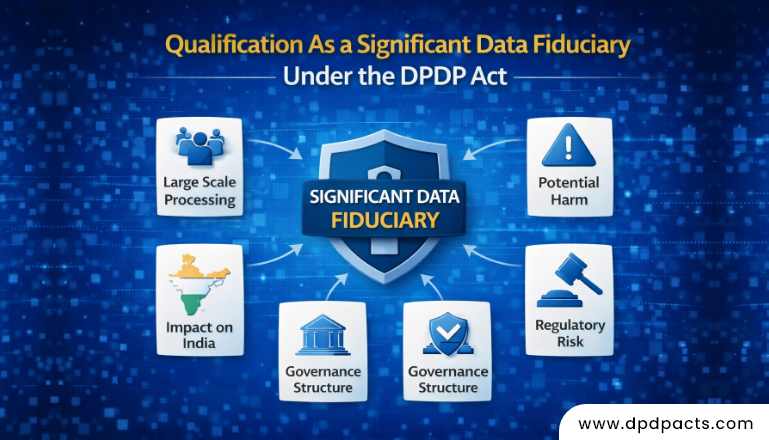
Who Qualifies As a Significant Data Fiduciary Under the DPDP Act

- Loading...
India’s digital transformation is happening at an unprecedented scale. From ordering groceries online to accessing healthcare, banking, and government services digitally, personal data has become the backbone of everyday life. But as data flows increase, so do concerns around privacy, misuse, and security.
Get a callback
To address these concerns, the Digital Personal Data Protection (DPDP) Act, 2023 introduces a structured framework for handling personal data responsibly. One of its most impactful provisions is the classification of certain organizations as Significant Data Fiduciaries (SDFs).
This isn’t just another regulatory label—it’s a signal that an organization plays a critical role in the data ecosystem and must meet higher standards of accountability.
Let’s explore this concept in depth.
The Foundation: What Is a Data Fiduciary?
At its core, the DPDP Act revolves around the concept of a Data Fiduciary.
A Data Fiduciary is any entity that:
- Determines the purpose of data collection
- Decides how personal data is processed
This includes:
- Tech platforms
- Banks and financial institutions
- E-commerce companies
- Healthcare providers
- Government bodies
In simple terms, if your organization decides “why” and “how” personal data is used, you are a Data Fiduciary.
However, not all Data Fiduciaries operate at the same scale or risk level. Some handle limited, low-risk data, while others process vast volumes of highly sensitive information. This distinction is what leads to the classification of Significant Data Fiduciaries.
Defining Significant Data Fiduciaries (SDFs)
A Significant Data Fiduciary is a Data Fiduciary that is formally notified by the Central Government based on specific risk-based criteria.
This classification is not automatic—it is deliberate and strategic.
The government evaluates whether an organization’s data practices could:
- Affect a large number of individuals
- Create substantial risk in case of misuse
- Influence national interests
In essence, SDFs are the “high-impact players” in India’s data economy.
The Risk-Based Approach: Why SDF Classification Exists
Unlike rigid regulatory frameworks, the DPDP Act adopts a risk-based approach.
This means:
- Not every organization is burdened with heavy compliance
- Regulatory focus is directed where it matters most
Why is this important?
Because:
- A small business collecting email IDs for newsletters doesn’t pose the same risk as a fintech platform handling financial transactions
- A local clinic doesn’t carry the same scale of risk as a nationwide health-tech database
The SDF framework ensures that compliance obligations are proportional to risk.
Key Criteria for Identifying Significant Data Fiduciaries
Under Section 10 of the DPDP Act, the government considers multiple factors before designating an entity as an SDF.
Let’s break these down in detail:
- Volume of Personal Data Processed
Scale matters—a lot.
Organizations processing data of large populations are more likely to be classified as SDFs.
Why?
- A breach affecting millions is far more damaging than one affecting hundreds
- Larger datasets increase exposure to cyber threats
While the Act doesn’t define a strict threshold, earlier discussions suggested figures like 100,000+ users as a reference point.
However, in reality:
- Major platforms may process data of millions or even billions
- Even mid-sized companies with rapid growth could fall under scrutiny
- Sensitivity of Personal Data
Not all data is created equal.
Sensitive data includes:
- Financial information (bank details, transactions)
- Health records
- Biometric identifiers (fingerprints, facial recognition)
- Government-issued IDs
Handling such data increases:
- Risk of identity theft
- Financial fraud
- Personal harm
Organizations dealing with highly sensitive datasets are strong candidates for SDF classification.
- Risk to Data Principals
The DPDP Act emphasizes the concept of Data Principals—the individuals whose data is being processed.
If data misuse can cause:
- Financial loss
- Emotional distress
- Reputational damage
- Discrimination
the organization’s risk profile increases significantly.
This criterion shifts the focus from data volume alone to real-world impact on individuals.
- Impact on National Interest
This is one of the most critical and unique aspects of the Indian framework.
Organizations may be classified as SDFs if their data practices affect:
- Sovereignty and integrity of India
- National security
- Electoral processes
- Public order
For example:
- Social media platforms influencing elections
- Apps handling sensitive geolocation data
- Entities managing critical infrastructure data
This criterion ensures that data protection aligns with national priorities.
Real-World Examples of Potential SDFs
Although official notifications determine SDF status, several categories of organizations are likely to fall under this classification.
Social Media and Technology Platforms
These platforms:
- Handle massive user bases
- Track user behavior continuously
- Influence public opinion
Risks include:
- Data leaks
- Algorithmic manipulation
- Misinformation
Fintech and Financial Institutions
Banks, digital wallets, and insurance providers:
- Process sensitive financial data
- Handle high transaction volumes
Risks include:
- Fraud
- Unauthorized transactions
- Identity theft
Healthcare and Health-Tech Companies
These entities:
- Store medical histories
- Manage diagnostic data
- Handle highly personal information
Risks include:
- Privacy violations
- Discrimination based on health data
HRMS and Data Processing Firms
Large organizations and service providers:
- Manage employee data
- Conduct background checks
- Process payroll
Risks include:
- Identity misuse
- Employment discrimination
Enhanced Compliance Obligations for SDFs
Once an entity is designated as an SDF, its responsibilities increase significantly.
Let’s explore these obligations in depth:
- Appointment of a Data Protection Officer (DPO)
SDFs must appoint a Data Protection Officer based in India.
Key responsibilities:
- Ensure compliance with the DPDP Act
- Act as a point of contact for users
- Handle grievances and complaints
Importantly:
- The DPO reports directly to the Board of Directors
- This ensures accountability at the highest level
- Independent Data Audits
SDFs must undergo regular audits by independent data auditors.
Purpose:
- Verify compliance
- Identify vulnerabilities
- Improve data governance
This ensures that organizations don’t just claim compliance—they prove it.
- Data Protection Impact Assessments (DPIAs)
Before undertaking high-risk processing activities, SDFs must conduct DPIAs.
These assessments:
- Identify potential risks
- Evaluate impact on individuals
- Recommend mitigation strategies
Think of DPIAs as preventive risk management tools.
- Periodic Compliance Reviews
Compliance is not a one-time effort.
SDFs must:
- Continuously monitor data practices
- Update policies regularly
- Adapt to evolving risks
This creates a culture of ongoing accountability.
- Stringent Data Breach Notification
In case of a data breach:
- SDFs must report quickly
- Provide detailed disclosures
- Take immediate corrective action
Delayed or inadequate reporting can lead to severe penalties.
Consequences of Non-Compliance
The DPDP Act introduces significant financial penalties.
For SDFs:
- Fines can go up to ₹150 crore (INR 1.5 billion)
But the impact goes beyond money:
- Loss of customer trust
- Reputational damage
- Legal scrutiny
In today’s digital world, trust is currency—and non-compliance erodes it rapidly.
Strategic Importance of SDF Classification
The SDF framework is more than just regulation—it’s a strategic tool for governance.
It helps:
- Protect individuals from large-scale harm
- Strengthen cybersecurity practices
- Build trust in digital services
- Align business practices with ethical standards
For businesses, it also acts as a wake-up call:
- Data protection is no longer optional—it’s a core business function.
How Organizations Can Prepare
Even if your organization isn’t currently classified as an SDF, preparing early is a smart move.
Key steps include:
- Building strong data governance frameworks
- Minimizing unnecessary data collection
- Investing in cybersecurity infrastructure
- Training employees on data privacy
- Conducting internal audits
Proactive preparation ensures:
- Smooth compliance
- Reduced legal risk
- Competitive advantage
Conclusion
The concept of Significant Data Fiduciaries under the DPDP Act, 2023 represents a major shift in India’s approach to data protection. It is built on a simple yet powerful idea: not all data handlers operate at the same scale or risk level, and those with greater influence over personal data must shoulder greater responsibility. By imposing stricter compliance obligations on high-risk entities, the Act adopts a balanced, risk-based framework that safeguards individuals’ rights while still allowing innovation to thrive. As India’s digital ecosystem continues to expand, Significant Data Fiduciaries will play a pivotal role in fostering a secure, trustworthy, and privacy-respecting environment.
Frequently Asked Questions (FAQs)
Q1. What is a Significant Data Fiduciary?
A1. An SDF is a Data Fiduciary classified by the government based on risk, scale, and sensitivity of data processing.
Q2. Is SDF classification automatic?
A2. No, entities are specifically notified by the Central Government.
Q3. What factors determine SDF status?
A3. Volume of data, sensitivity, risk to individuals, and impact on national interests.
Q4. Do startups need to worry about SDF rules?
A4. Yes, if they process large-scale or high-risk data, they can be classified as SDFs.
Q5. What is the role of a DPO?
A5. The DPO ensures compliance, handles grievances, and reports to senior management.
Q6. Are DPIAs mandatory for all companies?
A6. No, only for Significant Data Fiduciaries.
Q7. What is the penalty for non-compliance?
A7. Up to ₹150 crore, along with reputational and legal consequences.
Q8. Can SDF status change over time?
A8. Yes, the government can revise classifications based on evolving risks.
Q9. What industries are most likely to be SDFs?
A9. Tech, fintech, healthcare, and large data processing organizations.
Q10. How can companies prepare for SDF compliance?
A10. By implementing strong data governance, conducting audits, and ensuring transparency in data practices.