India’s data protection landscape has undergone a major transformation with the introduction of the Digital Personal Data Protection Act, 2023 (DPDP Act). The law establishes a comprehensive framework for processing digital personal data while imposing strict penalties for non-compliance.
For organizations—whether startups, SMEs, or large enterprises—the penalty provisions under the DPDP Act are not just regulatory clauses; they represent significant financial and reputational risks. In this blog, we’ll break down the penalty structure, explain how fines are determined, and outline practical strategies to stay compliant.
Understanding the Penalty Framework
The DPDP Act adopts a principle-based and risk-driven penalty regime. Instead of fixed fines for every violation, penalties are determined by the Data Protection Board of India based on:
- Nature of the breach
- Severity and impact
- Duration of non-compliance
- Whether the violation was intentional or negligent
- Steps taken to mitigate harm
This flexible approach ensures proportional penalties but also introduces uncertainty—making compliance even more critical.
Key Penalty Categories Under the DPDP Act
Here are the major categories of penalties imposed on Data Fiduciaries (organizations handling personal data):
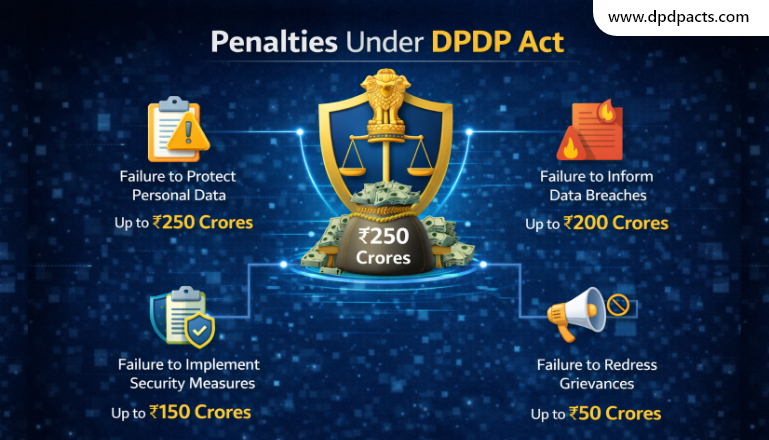
- Failure to Implement Reasonable Security Safeguards
Penalty: Up to ₹250 Crore
This is the maximum penalty under DPDP Act. If an organization fails to protect personal data from breaches due to weak security measures, it can face severe financial consequences.
Examples include:
- Poor encryption practices
- Lack of access controls
- Unsecured databases
- Failure to Notify Data Breach
Penalty: Up to ₹200 Crore
Organizations must promptly inform:
- The Data Protection Board
- Affected individuals
Failure to disclose breaches in a timely manner can result in heavy penalties.
- Violations Related to Children’s Data
Penalty: Up to ₹200 Crore
Processing children’s data comes with stricter obligations. Violations include:
- Tracking or behavioral monitoring
- Targeted advertising
- Lack of parental consent
This reflects the law’s emphasis on protecting vulnerable users.
- Non-Compliance by Significant Data Fiduciaries
Penalty: Up to ₹150 Crore
Entities classified as Significant Data Fiduciaries (SDFs) must comply with additional requirements such as:
- Data Protection Impact Assessments (DPIAs)
- Appointment of Data Protection Officers
- Independent audits
Failure to meet these obligations attracts substantial penalties.
- General Violations
Penalty: Up to ₹50 Crore
This includes all other non-compliance scenarios, such as:
- Improper consent mechanisms
- Failure to fulfill user rights
- Non-adherence to data retention rules
Penalties for Data Principals (Individuals)
Interestingly, the DPDP Act also introduces accountability for individuals.
Penalty: Up to ₹10,000
This may apply if a data principal:
- Files frivolous complaints
- Provides false or misleading information
This provision discourages misuse of grievance mechanisms.
Important Observations About DPDP Penalties
- No Compensation to Individuals
Penalties collected are paid to the government—not directly to affected users. Individuals may need separate legal remedies for compensation.
- No Fixed Minimum Penalty
The Board has discretion, meaning penalties can vary significantly depending on the case.
- Focus on Preventive Compliance
The law encourages organizations to adopt preventive controls rather than reactive fixes.
How the Data Protection Board Determines Penalties
The Data Protection Board of India evaluates multiple factors before imposing fines:
- Whether the breach caused harm to individuals
- Type and volume of personal data involved
- Repetitive nature of violations
- Cooperation during investigation
- Implementation of remedial actions
This ensures that penalties are fair yet strict enough to deter negligence.
Mitigation Strategies: How to Avoid Heavy Penalties
To reduce risk exposure, organizations should adopt a proactive compliance approach:
- Strengthen Security Infrastructure
- Use encryption and tokenization
- Implement zero-trust architecture
- Conduct regular vulnerability assessments
- Build Robust Consent Management
- Use clear and granular consent forms
- Maintain consent logs
- Enable easy withdrawal of consent
- Map Data Flows
- Identify what data is collected
- Track where it is stored and processed
- Ensure lawful purpose limitation
- Establish Breach Response Protocols
- Create incident response teams
- Define reporting timelines
- Conduct breach simulations
- Special Safeguards for Children’s Data
- Implement age verification mechanisms
- Avoid profiling and tracking
- Obtain verifiable parental consent
- Compliance for Significant Data Fiduciaries
- Appoint a Data Protection Officer (DPO)
- Conduct DPIAs regularly
- Maintain audit trails
Why DPDP Penalties Matter for Businesses
The financial penalties are significant—but the real risk goes beyond fines:
- Loss of customer trust
- Reputational damage
- Operational disruptions
- Increased regulatory scrutiny
In a digital economy, data trust is a competitive advantage. Non-compliance can erode it quickly.
Future Outlook
As enforcement mechanisms evolve, we can expect:
- More detailed rules and guidelines
- Increased regulatory oversight
- Sector-specific compliance expectations
Organizations that invest early in compliance will be better positioned to adapt.
Final Thoughts
The Digital Personal Data Protection Act, 2023 marks a major step toward strengthening data privacy in India. Its penalty framework sends a clear message: data protection is no longer optional.
Organizations must move beyond basic compliance and adopt a privacy-first mindset. Investing in data governance today is far less costly than paying penalties tomorrow.
Frequently Asked Questions (FAQs)
Q1. What is the maximum penalty under the DPDP Act?
A1. The maximum penalty is ₹250 crore, primarily for failure to implement reasonable security safeguards.
Q2. Who imposes penalties under the DPDP Act?
A2. Penalties are imposed by the Data Protection Board of India.
Q3. Can individuals be fined under this Act?
A3. Yes, individuals (data principals) can be fined up to ₹10,000 for false complaints or misinformation.
Q4. Are penalties fixed or flexible?
A4. They are flexible and depend on the severity, duration, and impact of the violation.
Q5. What is a Data Fiduciary?
A5. A Data Fiduciary is any entity that determines the purpose and means of processing personal data.
Q6. What is a Significant Data Fiduciary (SDF)?
A6. An SDF is a high-impact data processor identified by the government based on volume and sensitivity of data.
Q7. Do affected users receive compensation from penalties?
A7. No, penalties are paid to the government. Users must seek compensation separately.
Q8. What happens if a company fails to report a data breach?
A8. It may face penalties of up to ₹200 crore.
Q9. How can companies reduce the risk of penalties?
A9. By implementing strong security, consent management, data governance, and breach response systems.
Q10. Does the DPDP Act apply to startups?
A10. Yes, the Act applies to all entities processing digital personal data, including startups.