India’s digital economy is expanding at a rapid pace, with millions of users generating vast amounts of personal data every day. To safeguard this data and ensure responsible usage, the government introduced the Digital Personal Data Protection (DPDP) Act. This legislation marks a significant shift in how personal data is collected, processed, stored, and shared in India.
Among the many important concepts introduced in the Act, the role of the Data Processor is especially crucial. While most discussions tend to focus on “Data Fiduciaries” (organizations that decide why and how personal data is processed), Data Processors operate behind the scenes, enabling these activities through technical and operational support.
This blog provides a comprehensive understanding of who Data Processors are, what responsibilities they carry, how they differ from Data Fiduciaries, and why their role is essential in ensuring data protection compliance.
What is a Data Processor?
A Data Processor is any person or entity that processes personal data on behalf of a Data Fiduciary. In simpler terms, while the Data Fiduciary decides the purpose and means of processing personal data, the Data Processor executes those decisions.
For example:
- A company collects user data through its website (Data Fiduciary).
- It hires a cloud storage provider to store that data.
- The cloud provider acts as the Data Processor.
Data Processors do not independently decide how or why the data is processed—they follow the instructions given by the Data Fiduciary.
Key Characteristics of a Data Processor
To better understand their role, here are some defining characteristics:
1. Acts on Instructions
A Data Processor operates strictly based on the directions of the Data Fiduciary. They cannot use the data for their own purposes unless explicitly authorized.
2. No Ownership of Data
They do not “own” the personal data. Ownership and accountability remain primarily with the Data Fiduciary.
3. Technical or Operational Role
Their work is often technical in nature, such as:
- Data storage
- Data analysis
- IT services
- Payment processing
- Customer support systems
4. Bound by Contracts
Data Processors are typically governed by contracts or agreements that define how they must handle personal data.
Examples of Data Processors
Data Processors exist across industries and services. Some common examples include:
- Cloud service providers (for data hosting)
- Payment gateways handling transactions
- Analytics platforms tracking user behavior
- Email service providers sending marketing campaigns
- IT outsourcing firms managing databases
Even small vendors providing backend services can qualify as Data Processors if they handle personal data on behalf of another entity.
Responsibilities of Data Processors under the DPDP Act
While the DPDP Act primarily places compliance responsibility on Data Fiduciaries, Data Processors are not free from obligations. Their responsibilities are often enforced through contracts and regulatory expectations.
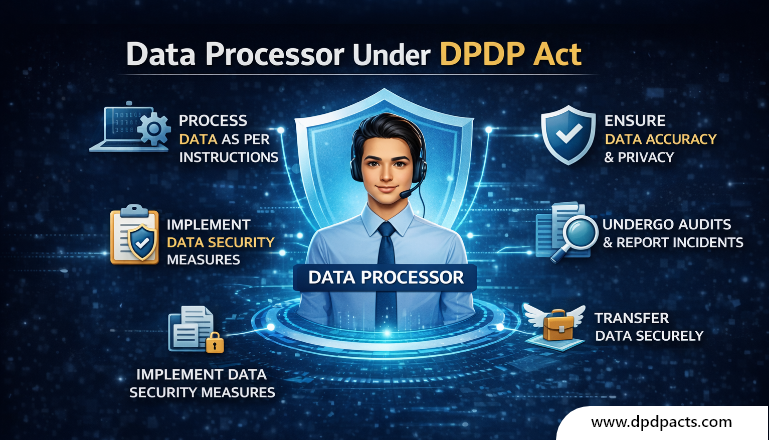
1. Processing Data Only as Authorized
Data Processors must process personal data strictly according to the instructions provided by the Data Fiduciary. Any deviation could lead to legal consequences.
2. Ensuring Data Security
They must implement appropriate technical and organizational measures to protect personal data from:
- Unauthorized access
- Data breaches
- Loss or corruption
This includes encryption, access controls, and regular security audits.
3. Assisting in Compliance
Data Processors must assist Data Fiduciaries in fulfilling their obligations, such as:
- Responding to user requests (access, correction, deletion)
- Reporting data breaches
- Conducting impact assessments (if required)
4. Maintaining Confidentiality
Employees and systems within a Data Processor’s organization must ensure that personal data remains confidential and is not misused.
5. Data Deletion or Return
Once the purpose of processing is fulfilled or the contract ends, Data Processors may be required to:
- Delete the data, or
- Return it to the Data Fiduciary
Data Processor vs Data Fiduciary
Understanding the difference between these two roles is essential.
| Aspect | Data Fiduciary | Data Processor |
| Decision-making | Determines purpose and means | Follows instructions |
| Accountability | Primary responsibility | Secondary, contractual |
| Control over data | High | Limited |
| Examples | E-commerce company | Cloud hosting provider |
In short, the Data Fiduciary is the “decision-maker,” while the Data Processor is the “executor.”
Importance of Data Processors in the Digital Ecosystem
Data Processors play a vital role in modern business operations. Without them, many digital services would not function efficiently.
1. Scalability
Organizations rely on processors like cloud providers to scale operations without investing heavily in infrastructure.
2. Specialization
Data Processors often bring technical expertise that Data Fiduciaries may lack.
3. Efficiency
Outsourcing data processing tasks helps companies focus on their core business activities.
4. Innovation
Advanced analytics and AI tools provided by processors enable businesses to derive insights and improve services.
Risks Associated with Data Processors
Despite their importance, Data Processors also introduce certain risks:
1. Data Breaches
If a processor has weak security, it can expose sensitive personal data.
2. Lack of Transparency
Data Fiduciaries may not always have full visibility into how processors handle data.
3. Cross-Border Data Transfers
Many processors operate globally, raising concerns about data being transferred outside India.
4. Sub-Processing
Processors may engage other processors (sub-processors), increasing complexity and risk.
Contractual Safeguards for Data Processors
To mitigate risks, Data Fiduciaries must enter into strong contractual agreements with Data Processors. These contracts typically include:
- Scope of data processing
- Security standards
- Confidentiality clauses
- Breach notification requirements
- Audit rights
- Data deletion policies
These agreements ensure that Data Processors remain accountable and compliant with the law.
Data Breach Responsibility
One important question often arises: Who is responsible in case of a data breach?
Under the DPDP Act:
- The Data Fiduciary is primarily responsible.
- However, the Data Processor may also face consequences if the breach occurred due to negligence or failure to follow instructions.
This shared responsibility makes it essential for both parties to maintain strong data protection practices.
Data Processing Agreements as Contractual Safeguards
- Subject Matter & Tenure of the Agreement:
The DPA must expressly indicate the scope of the data processing activity.
- Data Classification and Inventory:
The DPA should include a detailed classification of data, dividing it into categories such as personal data, sensitive data, and high-risk data. Appropriate safeguards must be applied, especially for high-risk data. - Breach Notification Clause:
The DPA must include a provision requiring the vendor to promptly inform the data fiduciary if any data breach is suspected or identified, including incidents like unauthorised access, data theft, or loss. - Staff Confidentiality Clause:
The DPA should ensure that all personnel who have access to the data fiduciary’s personal data are bound by strict confidentiality obligations to prevent any misuse or breach. - Audit and Compliance Clause:
The DPA must provide the data fiduciaries with the right to conduct audits and verify the data processor’s compliance with data protection requirements. - Sub-Processor Clause:
If the data processor appoints a sub-processor, the DPA should require prior authorisation from the data fiduciary. This helps manage third-party risks and ensures transparency and accountability.
Compliance Challenges for Data Processors
Data Processors face several challenges while aligning with the DPDP Act:
1. Understanding Legal Requirements
Many processors operate across jurisdictions and must comply with multiple data protection laws.
2. Managing Large Volumes of Data
Handling massive datasets increases the risk of errors and breaches.
3. Ensuring Consistent Security
Maintaining high security standards across systems and teams is complex.
4. Vendor Management
If sub-processors are involved, ensuring their compliance becomes an added responsibility.
Best Practices for Data Processors
To operate effectively and stay compliant, Data Processors should adopt the following best practices:
1. Implement Strong Security Measures
Use encryption, firewalls, and access controls to safeguard data.
2. Conduct Regular Audits
Periodic security and compliance audits help identify vulnerabilities.
3. Train Employees
Staff should be trained on data protection principles and best practices.
4. Maintain Documentation
Keep clear records of data processing activities and compliance measures.
5. Establish Incident Response Plans
Be prepared to quickly respond to data breaches or security incidents.
Future Outlook
As India’s digital ecosystem continues to grow, the role of Data Processors will become even more critical. With increasing reliance on cloud computing, AI, and data analytics, processors will handle larger volumes of sensitive data.
Regulatory scrutiny is also expected to increase, pushing Data Processors to adopt stricter compliance measures and higher transparency standards.
Organizations that proactively strengthen their data protection practices will not only comply with the law but also gain trust from customers and partners.
Conclusion
The Data Processor is a cornerstone of the data protection framework under the DPDP Act. While they may not determine how or why personal data is used, their role in executing these processes makes them indispensable.
From ensuring data security to supporting compliance efforts, Data Processors contribute significantly to the safe handling of personal data in today’s digital world.
However, with this role comes responsibility. Both Data Fiduciaries and Data Processors must work together, supported by strong contracts and robust security practices, to protect personal data and uphold user trust.
Understanding the role of Data Processors is not just important for legal compliance—it is essential for building a secure and sustainable digital future in India.
Frequently Asked Questions (FAQs)
Q1. What is a Data Processor under the DPDP Act?
A1. A Data Processor is any individual or organization that processes personal data on behalf of a Data Fiduciary. They do not decide the purpose of data processing but act strictly according to the instructions provided by the Data Fiduciary.
Q2. How is a Data Processor different from a Data Fiduciary?
A2. A Data Fiduciary determines why and how personal data is processed, while a Data Processor only executes those decisions. The Fiduciary holds primary accountability, whereas the Processor has a supportive and operational role.
Q3. Can a Data Processor use personal data for its own purposes?
A3. No, a Data Processor cannot use personal data for its own purposes unless explicitly authorized by the Data Fiduciary. Doing so would violate the DPDP Act and could lead to penalties.
Q4. Is a Data Processor directly liable under the DPDP Act?
A4. The DPDP Act primarily places responsibility on the Data Fiduciary. However, a Data Processor can still face consequences if it fails to follow contractual obligations or causes a data breach due to negligence.
Q5. Are contracts mandatory between Data Fiduciaries and Data Processors?
A5. Yes, contracts are essential. They define the scope of processing, security requirements, confidentiality obligations, and procedures for handling data breaches or termination of services.