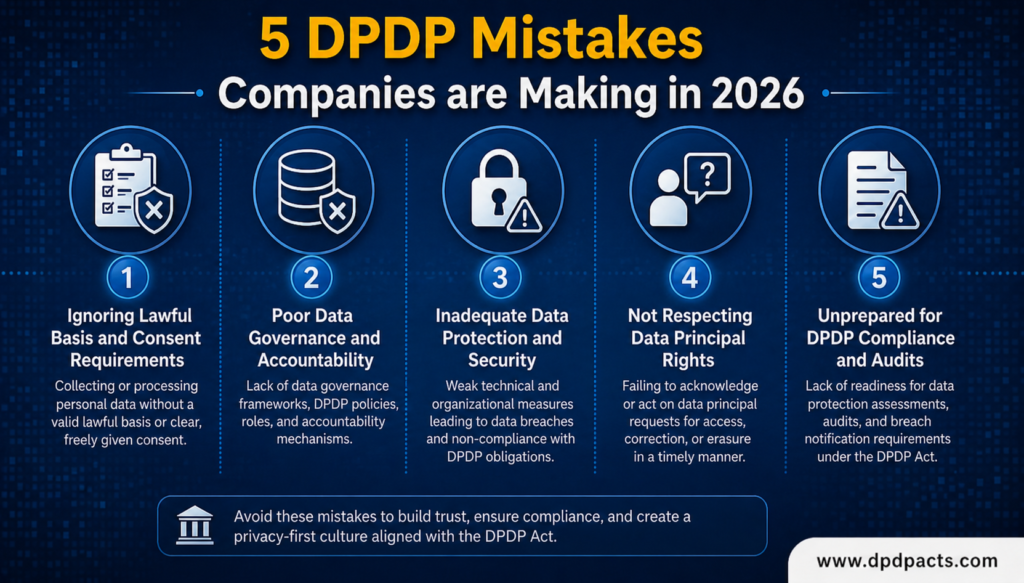
5 DPDP Mistakes Companies are Making in 2026

Listen to This Article
India’s data protection landscape has entered a decisive phase. With the enforcement of the Digital Personal Data Protection Act, 2023 in full swing in 2026, organizations are no longer asking “Do we need to comply?”—they’re asking “How do we stay compliant without breaking our business?”
Get a callback
And that’s where things get interesting.
Because despite widespread awareness, companies across sectors—startups, enterprises, and even digital-first organizations—are making critical mistakes that expose them to
1. Treating DPDP as a One-Time “Check-the-Box” Exercise
The Mistake
In 2025, many companies launched “DPDP compliance projects.” These typically included:
- Updating privacy policies
- Implementing cookie consent banners
- Creating internal documentation
Once completed, leadership assumed compliance was “done.”
The Reality
DPDP is fundamentally designed as a continuous compliance framework, not a one-time certification.
Unlike static regulatory requirements, DPDP expects organizations to:
- Continuously track how data flows across systems
- Regularly reassess risks
- Update policies based on operational changes
- Maintain real-time visibility into data usage
A company that was compliant in January 2025 can easily become non-compliant by March 2026 due to:
- New product features
- New third-party integrations
- Expansion into new markets
- Changes in consent mechanisms
Why Companies Fall Into This Trap
- Compliance treated as a legal task, not an operational one
- Lack of ownership beyond the legal or IT team
- No automation or monitoring tools
The Fix
Organizations need to shift from project-based compliance → program-based governance.
That includes:
- Creating a central data governance function
- Using tools for real-time data mapping and monitoring
- Conducting quarterly compliance audits
- Embedding privacy into product development (Privacy by Design)
The mindset shift is simple but powerful:
Compliance is not a milestone—it’s a muscle.
2. Assuming GDPR Compliance Covers DPDP
The Mistake
Many multinational companies and SaaS startups assume that compliance with the General Data Protection Regulation automatically ensures DPDP compliance.
It’s a logical assumption—but a flawed one.
The Reality
While GDPR and DPDP share philosophical similarities (consent, purpose limitation, user rights), their implementation details differ significantly.
Key differences include:
- Consent architecture: DPDP requires highly specific, user-friendly consent notices tailored to Indian users
- Children’s data rules: Stricter and more explicit under DPDP
- Regulatory structure: Enforcement through the Data Protection Board of India
- Significant Data Fiduciary (SDF) classification with additional obligations
A company relying solely on GDPR frameworks often misses local nuances, creating hidden compliance gaps.
Why This Happens
- Over-reliance on global compliance templates
- Lack of India-specific legal interpretation
- Underestimating regulatory differences
The Fix
Conduct a DPDP-specific gap analysis, even if GDPR-compliant.
Focus areas:
- Consent flow redesign
- Data retention and deletion policies
- User rights management systems
- Localization of privacy notices
Think of GDPR as a foundation, not a finished structure.
3. Ignoring Vendor and Processor Data Liability
The Mistake
“Data is processed by a third party, so they’re responsible.”
This assumption is one of the most expensive misunderstandings under DPDP.
The Reality
The DPDP framework clearly defines the role of a Data Fiduciary—the entity that determines why and how data is processed.
Even if processing is outsourced, liability is not.
If a breach occurs at:
- A cloud provider
- A CRM platform
- A marketing automation tool
The Data Fiduciary is still accountable.
Real-World Risk Scenario
A company integrates a third-party analytics tool that stores user data improperly. A breach occurs.
Even though the vendor caused the issue:
- The company faces penalties
- Users lose trust
- Regulatory scrutiny increases
Why Companies Miss This
- Rapid vendor onboarding without due diligence
- Legacy contracts not updated for DPDP
- Lack of visibility into vendor data practices
The Fix
Adopt a zero-trust vendor governance model:
- Conduct vendor risk assessments before onboarding
- Update contracts with:
- Data Processing Agreements (DPAs)
- Breach notification clauses
- Audit rights
- Continuously monitor vendor compliance
In 2026, vendor management = risk management.
4. Failing to Enable Automated Data Deletion
The Mistake
Many companies still follow the outdated philosophy:
“More data is better.”
So they store:
- Old customer records
- Inactive user data
- Redundant backups
indefinitely.
The Reality
DPDP enforces purpose limitation and storage limitation, grounded in principles like Data Minimization.
This means:
- Data must be deleted once its purpose is fulfilled
- Data must be erased when consent is withdrawn
- Users must receive advance notice (48 hours) before deletion
Holding unnecessary data:
- Increases breach exposure
- Raises compliance risk
- Expands legal liability
Why This Happens
- Legacy systems not designed for deletion
- Fear of losing “potentially useful” data
- Lack of automation
The Fix
Implement automated data lifecycle management systems:
- Define retention timelines for each data category
- Automate deletion triggers
- Maintain audit logs for regulatory proof
- Ensure deletion propagates across all systems
The safest data is the data you don’t keep.
5. Inadequate Breach Notification and Response Plans
The Mistake
Many companies don’t have a structured incident response plan—or they have one that exists only on paper.
The Reality
DPDP mandates strict breach reporting timelines:
- Notify the Data Protection Board of India
- Do so within 72 hours of becoming aware of a breach
Failure to comply can lead to penalties up to ₹200 crore.
But beyond penalties, the real damage comes from:
- Customer distrust
- Media exposure
- Business disruption
Why Companies Struggle
- No predefined escalation workflows
- Lack of coordination between legal, IT, and leadership
- No simulation or training
The Fix
Build a battle-ready incident response framework:
- Create a clear breach response playbook
- Assign roles and responsibilities
- Appoint a Data Protection Officer (DPO)
- Conduct regular mock breach drills
In a breach, speed is everything. Preparation determines survival.
The Bigger Picture: Compliance as Competitive Advantage
The companies that are thriving under DPDP in 2026 are not just compliant—they’re strategically aligned with privacy.
They treat data protection as:
- A trust signal for customers
- A differentiator in competitive markets
- A core business capability
Meanwhile, companies that treat DPDP as a burden are:
- Reacting instead of preparing
- Paying penalties instead of investing in systems
- Losing trust instead of building it
Frequently Asked Questions
Q1. What is the DPDP Act in simple terms?
A1. The Digital Personal Data Protection Act, 2023 governs how personal data is collected, used, and stored in India
Q2. Who enforces DPDP in India?
A2. The Data Protection Board of India oversees compliance and handles violations. It has the authority to investigate and impose penalties.
Q3. What is a Data Fiduciary?
A3. A Data Fiduciary is any entity that decides why and how personal data is processed. This includes companies, startups, and even certain government bodies.
Q4. What is a Significant Data Fiduciary (SDF)?
A4. SDFs are organizations handling large volumes of sensitive data or posing higher risks. They must follow stricter rules like audits, DPIAs, and appointing a DPO.
Q5. What is the maximum penalty under DPDP?
A5. Penalties can go up to ₹250 crore for serious violations. The amount depends on the nature and impact of the breach.
Q6. Is GDPR compliance enough for DPDP?
A6. No, the General Data Protection Regulation does not fully cover DPDP requirements. Companies must address India-specific rules and compliance gaps.
Q7. What is the breach notification timeline?
A7. Organizations must report data breaches within 72 hours of becoming aware. Delays can lead to heavy financial penalties.
Q8. Can companies store data indefinitely?
A8. No, data must be deleted once its purpose is fulfilled or consent is withdrawn. Keeping unnecessary data increases compliance and security risks.
Q9. Are third-party vendors liable for breaches?
A9. Vendors can be liable, but the primary responsibility lies with the Data Fiduciary. Companies must ensure vendors follow DPDP-compliant practices.
Q10. How can companies stay compliant long-term?
A10. By implementing continuous monitoring, regular audits, and automated data management. Embedding privacy into daily operations is key to sustained compliance.