How to Manage Consent Records Under DPDP without Spreadsheets

- Loading...
If your organization is still using spreadsheets to track user consent, you’re relying on a system that was never designed for compliance, scale, or accountability. That might have worked in a pre-regulation era—but under India’s Digital Personal Data Protection Act, 2023, consent is not just a record. It’s a living, traceable, and user-controlled agreement.
And spreadsheets simply can’t keep up.
Get a callback
In this blog, we’ll explore how businesses can transition from manual tracking to automated, compliant, and user-friendly consent management systems—without losing control or adding unnecessary complexity.
The Shift: From Static Records to Dynamic Consent
Traditionally, consent was treated as a one-time checkbox:
- A user clicks “I agree”
- A record is stored
- And that’s the end of it
But DPDP fundamentally changes this approach.
Consent must now be:
- Granular (specific to purpose)
- Informed (clear and understandable)
- Freely given (no coercion or bundling)
- Revocable (easy to withdraw anytime)
- Auditable (you must prove it)
This transforms consent from a static entry into a continuous lifecycle—one that spreadsheets are fundamentally unequipped to manage.
Why Spreadsheets Are a Compliance Risk
Spreadsheets are popular because they’re simple. But simplicity becomes a liability under strict regulatory frameworks.
Here’s where they fall apart:
- No Real-Time Synchronization
If a user withdraws consent, how quickly does that update reflect across all systems?
In spreadsheets, the answer is often: too late.
- High Risk of Human Error
Manual data entry leads to:
- Incorrect timestamps
- Missing records
- Version mismatches
Even small errors can invalidate consent.
- No Immutable Audit Trail
Spreadsheets can be edited, overwritten, or deleted—making them unreliable during audits.
- Lack of Automation
Consent withdrawal should automatically stop data processing. Spreadsheets require manual intervention, which creates compliance gaps.
- Poor Scalability
Managing thousands (or millions) of users across multiple products? Spreadsheets quickly become unmanageable.
The Modern Solution: Automated Consent Management
To comply with DPDP, organizations must adopt systems that are:
- Automated
- Secure
- User-centric
- Integration-friendly
Let’s explore the key building blocks.
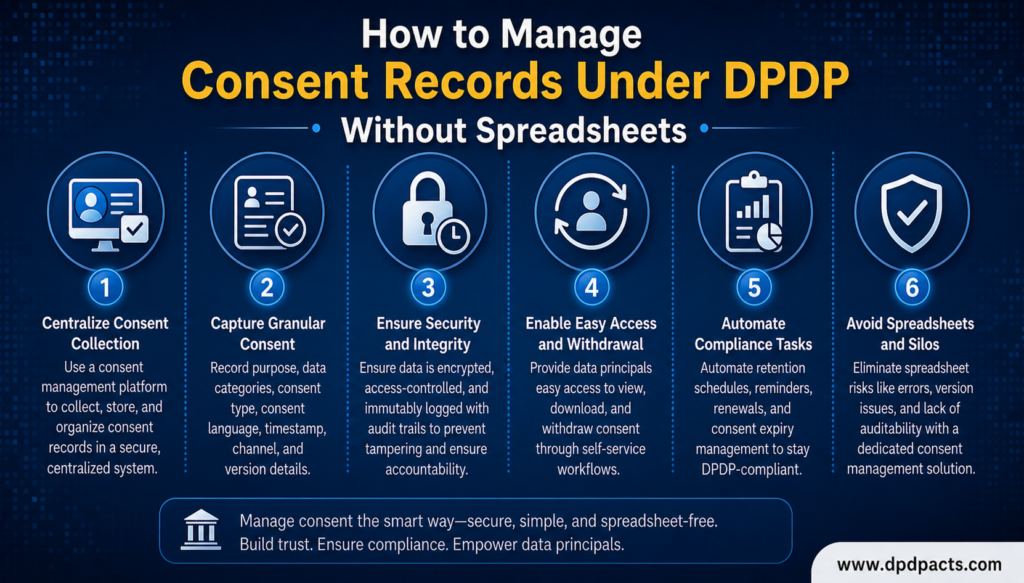
1. Consent Management Platforms (CMPs): Your Compliance Backbone
A Consent Management Platform replaces fragmented tracking with a unified system.
What a CMP does:
- Captures consent across websites, apps, and offline channels
- Stores encrypted, timestamped consent records
- Maintains version history of consent notices
- Provides a centralized dashboard for monitoring
Why it matters:
A CMP ensures that every consent interaction is:
- Logged automatically
- Stored securely
- Easily retrievable during audits
Real-world advantage:
Instead of searching through spreadsheets during a compliance check, you can generate a full audit trail in seconds.
2. Consent Manager APIs: Real-Time, System-Wide Sync
Under DPDP, Consent Managers act as intermediaries that allow users to manage their consent centrally.
By integrating with Consent Manager APIs, you can:
- Log consent events instantly
- Sync updates across all internal and third-party systems
- Trigger workflows using webhooks
Example:
A user withdraws consent via a mobile app →
API triggers →
CRM, marketing tools, and analytics systems immediately stop processing data.
No manual updates. No delays.
3. Self-Service Privacy Portals: Putting Users in Control
DPDP emphasizes user empowerment—and this is where self-service portals come in.
What users can do:
- View what data is being processed
- See purposes for which consent was given
- Modify preferences
- Withdraw consent anytime
- Access historical logs
Why this matters:
Transparency reduces:
- User complaints
- Legal disputes
- Compliance risks
And increases:
- Trust
- Engagement
- Brand credibility
A well-designed privacy dashboard turns compliance into a user experience advantage.
4. Digital Consent Capture: Replacing Paper and Manual Forms
Consent must be verifiable and non-repudiable—meaning users cannot later deny giving it.
Modern digital methods include:
OTP-Based Consent
- User receives a one-time password
- Enters it to confirm consent
- System logs timestamp and verification
Aadhaar / DigiLocker Integration
- Useful for high-assurance scenarios
- Ensures identity verification
- Especially relevant for sensitive use cases
Digital Signatures
- Provide strong legal validity
- Automatically generate audit trails
Key benefit:
Every consent interaction becomes a secure, traceable digital event—not a fragile manual record.
5. Privacy-Enhancing Technologies (PETs): Smarter Data Handling
One of the biggest risks in consent management is storing too much personal data alongside consent records.
PETs solve this by:
- Separating consent from personal data
- Using anonymized or tokenized identifiers
- Implementing secure, “data-blind” systems
Immutable Logging
Using technologies like append-only databases or distributed ledgers ensures:
- Records cannot be altered
- Audit trails remain intact
- Compliance is easier to prove
Why this matters:
Even if a system is compromised, sensitive user data remains protected.
Designing a Robust Consent Artefact
Regardless of the system you use, your “consent artefact” must capture:
- Who
A unique identifier (email hash, user ID, token)
- When
Precise timestamp of consent action
- What
Version of the consent notice shown
- Purpose
Specific purpose(s) approved
- How
Method of consent capture (OTP, click, signature)
This structured record ensures you can demonstrate compliance at any time.
Implementation Roadmap: Moving Away from Spreadsheets
Transitioning doesn’t have to be overwhelming. A phased approach works best:
Step 1: Audit Current Consent Flows
Identify:
- Where consent is collected
- How it’s stored
- Where gaps exist
Step 2: Choose the Right CMP
Look for:
- DPDP-specific features
- API capabilities
- Scalability
Step 3: Integrate Systems
Connect CMP with:
- CRM
- Marketing tools
- Analytics platforms
Step 4: Launch Privacy Portal
Give users visibility and control.
Step 5: Automate Workflows
Ensure consent changes trigger immediate system-wide updates.
Common Mistakes to Avoid
Even with modern tools, organizations often stumble:
- Treating consent as a one-time event
- Bundling multiple purposes into one checkbox
- Making withdrawal difficult
- Not maintaining version history of notices
- Ignoring third-party data processors
Avoiding these mistakes is just as important as adopting the right technology.
The Bigger Picture: Compliance as a Growth Driver
It’s easy to view DPDP compliance as a burden. But forward-thinking companies see it differently.
Benefits beyond compliance:
- Stronger customer trust
- Better data quality
- Reduced legal risk
- Improved operational efficiency
In a data-driven economy, trust is currency—and consent management is how you earn it.
Conclusion
Managing consent under the Digital Personal Data Protection Act, 2023 is not just about avoiding penalties—it’s about building a system that respects user choice, ensures transparency, and scales with your business.
Spreadsheets can’t deliver that.
By adopting automated platforms, integrating APIs, enabling user control, and leveraging privacy-enhancing technologies, organizations can transform consent management from a compliance headache into a strategic advantage.
The question is no longer whether to move beyond spreadsheets—but how soon you can do it.
FAQs
Q1. What is DPDP and why is it important?
A1. The Digital Personal Data Protection Act, 2023 is India’s primary data protection law that regulates how organizations collect, use, and store personal data.
Q2. Can small businesses avoid using CMPs?
A2. Small businesses are not legally required to use a CMP, but relying on manual methods like spreadsheets increases compliance risks significantly.
Q3. How does consent withdrawal work technically?
A3. When a user withdraws consent, APIs and webhooks instantly notify all connected systems to stop processing that user’s data.
Q4. What is a consent artefact?
A4. A consent artefact is a digital proof that records when, how, and for what purpose a user gave consent.
Q5. Is OTP-based consent legally valid?
A5. Yes, OTP-based consent is valid if it clearly links the action to the user and is properly logged with timestamps.
Q6. Do I need to store full personal data with consent?
A6. No, it’s safer to store a unique identifier instead of full personal data alongside consent records.
Q7. What are Consent Managers?
A7. Consent Managers are registered entities under DPDP that allow users to manage and control their consent across platforms.
Q8. How often should consent be refreshed?
A8. Consent should be refreshed whenever there are changes in purpose, policy, or data usage practices.
Q9. What happens during a compliance audit?
A9. Organizations must present verifiable, tamper-proof records showing how and when consent was obtained.
Q10. What are the penalties for non-compliance?
A10. Non-compliance with the Digital Personal Data Protection Act, 2023 can result in penalties of up to ₹250 crore per violation.