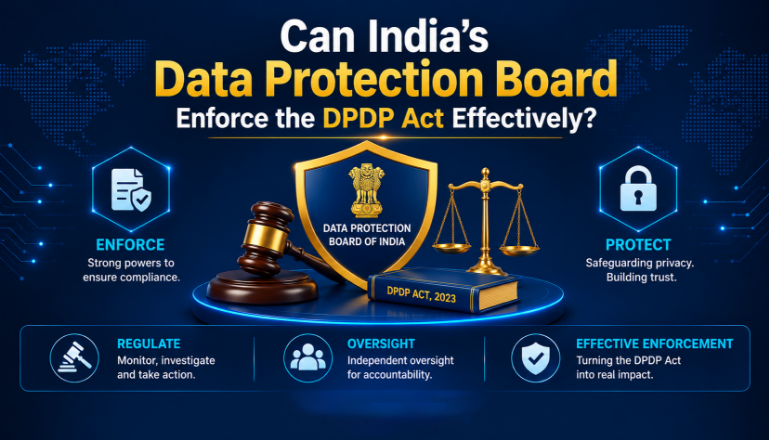
Can India’s Data Protection Board Enforce the DPDP Act Effectively? The Case for Scalable and Federated Enforcement

- Loading...
India’s Digital Personal Data Protection Act, 2023 (DPDP Act) establishes a new legal framework for regulating the processing of digital personal data. At the centre of this framework is the Data Protection Board of India (DPBI), the statutory body responsible for handling specified breaches, complaints, inquiries and enforcement proceedings under the Act.
Get a callback
The creation of a specialised data protection regulator is an important step for India. But the more difficult question is not whether India needs a Data Protection Board. It is whether a predominantly centralised enforcement architecture can scale effectively across India’s enormous digital economy, millions of organisations, diverse sectors and hundreds of millions of individuals.
This question becomes particularly important as the DPDP framework moves from legislation toward implementation through the Digital Personal Data Protection Rules, 2025. The Rules provide detailed operational requirements covering areas such as notices, consent managers, security safeguards, personal-data breach notifications, retention and children’s data. Their commencement is phased, making regulatory capacity and institutional readiness especially important.
This article examines the enforcement architecture of the DPDP Act, identifies its potential challenges and considers whether India should eventually move toward a more distributed or federated model of data-protection enforcement.
1. Why Enforcement Matters More Than the Text of the Law
A data protection law ultimately succeeds not merely because it creates rights and obligations, but because those rights and obligations can be enforced in practice.
The DPDP Act creates obligations for Data Fiduciaries, rights for Data Principals and powers for the Data Protection Board. For example, Data Fiduciaries are responsible for complying with the Act and the Rules, implementing appropriate technical and organisational measures, taking reasonable security safeguards and establishing grievance-redressal mechanisms.
The Act also provides individuals with rights including access to information, correction and erasure of personal data, grievance redressal and nomination rights.
But a statutory right has limited practical value if an individual cannot easily:
- understand that a violation has occurred;
- approach the responsible organisation;
- obtain meaningful grievance redressal;
- escalate unresolved issues;
- obtain a timely regulatory decision; or
- secure an effective remedy.
This is why the institutional design of the Data Protection Board is as important as the substantive provisions of the Act.
2. What Does the DPDP Act Actually Give the Data Protection Board?
The DPDP Act establishes the Data Protection Board of India under Section 18. The Board is constituted as a body corporate, and its Chairperson and Members are appointed by the Central Government in the manner prescribed. The Act also requires Members to possess relevant ability, integrity, standing and expertise, with at least one Member being an expert in law.
The Board’s enforcement functions are primarily set out in Section 27.
These include acting on:
- intimation of a personal-data breach;
- complaints made by Data Principals;
- references from the Central or State Government;
- directions of a court;
- complaints concerning Consent Managers; and
- specified breaches involving intermediaries.
The Board can inquire into relevant breaches and impose penalties where the statutory requirements are satisfied.
Section 28 further provides the procedural framework for inquiries. The Board determines whether sufficient grounds exist to proceed, can inquire into the affairs of a person to determine compliance, must follow principles of natural justice and has specified powers comparable to those of a civil court for matters such as summoning persons and requiring documents.
Therefore, describing the DPBI simply as a “complaint office” would be inaccurate. The Act gives it significant adjudicatory and enforcement responsibilities.
The real question is whether those powers are sufficient to create effective enforcement at national scale.
3. The Centralisation Question
India’s DPDP framework places the principal statutory enforcement function in a single national Board rather than creating separate state-level data protection authorities.
There are advantages to this model.
A single regulator can potentially provide:
- consistent interpretation of the law;
- uniform enforcement standards;
- centralised expertise;
- standardised procedures;
- lower institutional duplication;
- a single national digital grievance infrastructure; and
- more consistent treatment of businesses operating across multiple states.
For businesses, this can actually be attractive.
A company operating in Delhi, Maharashtra, Karnataka and Tamil Nadu would ideally prefer one predictable national regulatory framework rather than four potentially different regulatory interpretations.
However, centralisation also creates a capacity question.
4. Can One National Regulator Handle India’s Data Economy?
India’s digital economy is not concentrated in a handful of large technology companies.
Personal data is processed by:
- banks and financial institutions;
- hospitals and healthcare providers;
- schools and universities;
- e-commerce platforms;
- telecom companies;
- insurance companies;
- employers;
- mobile applications;
- SaaS companies;
- digital marketplaces;
- advertising businesses;
- government departments;
- startups and small businesses; and
- thousands of vendors and Data Processors.
The volume of personal-data processing is therefore potentially enormous.
A national regulator must be capable of dealing not only with major breaches involving large technology companies, but also with ordinary privacy failures affecting individuals.
Consider a hypothetical example.
A local educational platform collects parents’ and students’ information. It fails to implement appropriate security safeguards and a personal-data breach occurs.
The legal framework may provide the affected individual with a route to grievance redressal.
But if thousands of comparatively small organisations generate similar complaints, the regulatory challenge becomes one of capacity, prioritisation and scalability.
A regulator that investigates every matter manually could become overwhelmed.
A regulator that investigates only major cases could create an enforcement gap for smaller Data Fiduciaries.
This is the central enforcement challenge.
5. The Risk of Enforcement Concentration
One potential consequence of a centralised regulator is enforcement concentration.
Large companies naturally attract more attention because:
- they process large volumes of data;
- their breaches can affect millions of people;
- their cases create important precedents;
- they attract media attention; and
- their enforcement actions may have greater deterrent value.
But data protection problems do not occur only at large corporations.
A small business can mishandle customer information.
A local service provider can expose personal records.
An educational institution can inadequately protect student data.
A healthcare provider can disclose information improperly.
A vendor acting as a Data Processor can introduce vulnerabilities into a larger organisation’s supply chain.
Effective data protection therefore requires an enforcement system that can address both high-impact systemic violations and routine individual grievances.
6. The DPDP Rules Add a New Layer of Regulatory Responsibility
The enforcement question becomes more important because the 2025 Rules turn several broad statutory obligations into more operational requirements.
For example, the Rules specify security safeguards involving measures such as encryption, obfuscation, masking or virtual tokens, access controls, logging and monitoring, backups, contractual safeguards and organisational measures.
The Rules also prescribe a structured personal-data breach notification framework.
Affected Data Principals are to receive clear information concerning the breach, including its nature and extent, timing, potential consequences, mitigation measures and information about whom they can contact. The Board is also to receive breach information, with further details required within the prescribed period.
This means enforcement will increasingly involve not just interpreting broad privacy principles, but evaluating:
- security controls;
- breach response;
- consent mechanisms;
- notices;
- retention practices;
- grievance systems;
- children’s data processing;
- Consent Manager compliance; and
- organisational accountability.
The regulator therefore needs legal, technical and operational capacity simultaneously.
7. A Data Protection Regulator Cannot Be Only a Legal Institution
Modern privacy enforcement is inherently multidisciplinary.
A serious data breach may require understanding:
- cloud infrastructure;
- encryption;
- identity and access management;
- database architecture;
- application security;
- logging;
- data flows;
- AI systems;
- advertising technology;
- third-party tracking;
- cross-border processing; and
- automated decision-making.
The DPDP Act itself recognises the importance of specialised expertise. Section 19 provides that Board members should possess knowledge or practical experience in areas including data governance, administration, dispute resolution, information and communication technology, digital economy, law, regulation and techno-regulation.
This is important because data protection enforcement is no longer simply a question of reading contracts and interpreting legislation.
It increasingly requires technical regulatory capability.
8. Independence Is an Important Institutional Question
Another issue is institutional independence.
The Act provides for appointment of the Chairperson and Members by the Central Government in the manner prescribed. At the same time, Section 28 expressly states that the Board shall function as an independent body.
These provisions create an important institutional design question.
A regulator must potentially oversee organisations across the private and public sectors. Government bodies themselves can process significant amounts of personal data.
For public confidence, it is therefore important that the Board’s decision-making is perceived as:
- independent;
- transparent;
- evidence-based;
- technically competent;
- procedurally fair; and
- insulated from inappropriate external influence.
Independence is not merely about formal statutory language. It is also about institutional practice, appointment processes, resources, expertise and transparency.
9. Government Processing and the Enforcement Challenge
The DPDP Act contains specific exemptions and special provisions concerning certain categories of processing.
Section 17, for example, provides exemptions in specified circumstances, including processing necessary for legal rights and claims, judicial or regulatory functions, prevention or investigation of offences, certain corporate restructuring activities and specified financial information processing. It also permits certain exemptions relating to State instrumentalities and other categories specified in the Act.
These provisions are not automatically evidence of weak regulation. Many privacy laws around the world contain exemptions for law enforcement, national security, judicial functions and other public-interest purposes.
The important issue is how narrowly and transparently those exemptions are applied.
A mature data protection system must maintain a difficult balance:
Privacy protection + legitimate State functions + accountability.
Overly broad exemptions can weaken privacy protection.
Overly narrow exemptions can interfere with legitimate public functions.
The quality of implementation will therefore matter enormously.
10. Why a Federated Model Is Worth Considering
A “federated” model does not necessarily mean replacing the national Data Protection Board with separate state regulators.
A more practical approach could retain the DPBI as the national coordinating and adjudicatory authority, while creating specialised regional or sectoral enforcement mechanisms.
Such a model could have three layers.
Layer 1: National Data Protection Board
The national Board would retain responsibility for:
- national policy interpretation;
- major systemic cases;
- cross-state matters;
- significant Data Fiduciaries;
- major data breaches;
- cross-border issues;
- national enforcement standards;
- regulatory coordination; and
- appellate or inter-regulatory cooperation.
Layer 2: Regional Enforcement Hubs
Regional offices or digital enforcement hubs could assist with:
- local grievances;
- awareness;
- preliminary complaint handling;
- compliance education;
- regional-language support;
- small and medium-sized Data Fiduciaries;
- local-sector monitoring; and
- escalation of serious matters to the national Board.
These need not necessarily become completely independent statutory regulators.
They could function as operational extensions of a single national regulatory system.
Layer 3: Sectoral Expertise
Some privacy risks are highly sector-specific.
Healthcare data is different from advertising data.
Financial data is different from educational data.
Children’s data presents different risks from ordinary customer data.
The enforcement framework could therefore also develop specialised regulatory capacity for high-risk sectors.
This would allow the national Board to remain coherent while developing deep technical expertise.
11. Federated Does Not Mean Fragmented
One of the strongest arguments against multiple regulators is regulatory fragmentation.
Businesses should not have to comply with different interpretations of the same national law in every state.
Therefore, any federated model should preserve:
- one national law;
- common compliance standards;
- common procedural rules;
- interoperable regulatory technology;
- central guidance;
- common reporting formats;
- coordinated enforcement;
- a unified case-management system; and
- consistent interpretation of major legal questions.
The objective should be:
distributed enforcement, not fragmented regulation.
That distinction is critical.
12. Technology Could Make a Federated System Scalable
India has an opportunity to design a regulator that is digital by default.
The DPDP Act itself requires the Board to function, as far as practicable, as a digital office, with digital receipt of complaints, allocation, hearings and decisions.
This could evolve into a national regulatory technology platform.
For example, the system could provide:
Digital complaint intake
Individuals should be able to submit complaints through a simple interface and track their status.
Automated triage
Complaints could initially be classified according to:
- severity;
- number of individuals affected;
- type of data;
- vulnerability of affected persons;
- repeat violations;
- breach severity; and
- systemic importance.
Regulatory dashboards
The Board could monitor:
- breach volumes;
- grievance resolution times;
- recurring violations;
- repeat offenders;
- sector-specific trends;
- unresolved complaints; and
- emerging privacy risks.
Risk-based supervision
Rather than treating every Data Fiduciary identically, regulatory resources could be concentrated on organisations presenting the greatest potential harm.
This is particularly important because the Indian digital ecosystem includes organisations with dramatically different levels of risk and processing volume.
13. Small Businesses Should Not Become Invisible
A common regulatory mistake is to focus exclusively on large organisations.
Small and medium-sized businesses often lack:
- dedicated privacy teams;
- Data Protection Officers;
- specialist lawyers;
- cybersecurity departments; and
- sophisticated compliance technology.
That does not mean they should be exempt from accountability.
Instead, the regulatory system should combine enforcement with compliance assistance.
For example, the regulator could publish:
- model privacy notices;
- model Data Processor agreements;
- breach-response templates;
- sector-specific compliance guides;
- standard retention schedules;
- children’s-data guidance;
- security checklists;
- grievance-response templates; and
- simplified compliance resources for startups and SMEs.
This would improve compliance without requiring every small business to build a large legal department.
14. The Role of Consent Managers
Consent Managers are another important component of India’s framework.
The DPDP Act defines a Consent Manager as an entity registered with the Board that enables a Data Principal to give, manage, review and withdraw consent through an accessible, transparent and interoperable platform.
The 2025 Rules establish requirements around registration and responsibilities of Consent Managers.
If implemented effectively, Consent Managers could generate useful compliance information.
However, consent records should not become a substitute for broader regulatory oversight.
A company can have a technically perfect consent-management system and still have problems with:
- excessive collection;
- inadequate security;
- unlawful disclosure;
- excessive retention;
- poor vendor management; or
- inadequate grievance handling.
Consent is one part of a broader data-governance framework.
15. Enforcement Should Be Risk-Based
India does not necessarily need to investigate every organisation in the same way.
A better approach would be risk-based enforcement.
Factors could include:
- volume of personal data processed;
- sensitivity of data;
- number of individuals affected;
- processing of children’s data;
- use of automated systems;
- history of violations;
- frequency of breaches;
- cross-border processing;
- dependence on third-party processors; and
- potential impact on individuals.
This approach would allow regulatory resources to be concentrated where violations could cause the greatest harm.
16. Penalties Are Only One Part of Enforcement
The DPDP Act provides for monetary penalties where the Board determines that a breach is significant. Section 33 requires the Board to consider factors including the nature, gravity and duration of the breach, the type of personal data affected, whether the breach is repetitive, mitigation efforts and proportionality when determining the amount of penalty.
This is important because effective enforcement is not simply about imposing the largest possible fine.
A mature enforcement system should also produce:
- corrective action;
- improved security;
- better notices;
- stronger governance;
- improved grievance handling;
- responsible retention practices;
- better processor management; and
- meaningful remediation for affected individuals.
The ultimate objective is better behaviour, not merely more penalties.
17. What Should India Prioritise?
A scalable DPDP enforcement ecosystem could focus on seven priorities.
1. Build strong national expertise
The Data Protection Board should have access to legal, regulatory, cybersecurity, technology, economics and privacy expertise.
2. Create regional accessibility
Regional offices or digital hubs could make the system easier to access without creating conflicting state-level privacy laws.
3. Develop sector-specific expertise
Healthcare, finance, education, advertising and children’s services may require specialised regulatory knowledge.
4. Use regulatory technology
Digital complaint management, automated triage, analytics and risk monitoring can help the Board scale.
5. Publish enforcement guidance
Businesses need predictable expectations about what constitutes adequate compliance.
6. Support SMEs
Small businesses should have access to practical compliance tools rather than only enforcement notices.
7. Measure regulatory performance
The Board should publish appropriate statistics concerning:
- complaints received;
- complaints resolved;
- average resolution times;
- breach notifications;
- enforcement actions;
- penalties;
- recurring violations; and
- sectoral trends.
Transparency can help build public confidence and allow policymakers to identify capacity problems early.
18. The Way Forward: One National Regulator, Distributed Capability
India does not necessarily have to choose between a completely centralised regulator and a collection of independent state-level regulators.
There is a third possibility.
The country can maintain one national Data Protection Board while distributing operational capability across regions, sectors and digital platforms.
This model could preserve consistency while improving accessibility and scalability.
The national Board would remain responsible for the integrity of the legal framework.
Regional and sectoral mechanisms would provide reach.
Technology would provide scale.
Risk-based supervision would provide prioritisation.
Transparency would provide accountability.
Together, these elements could create a more resilient enforcement ecosystem.
Conclusion
The DPDP Act 2023 gives India the foundation for a national data-protection regime. The Data Protection Board of India is a central part of that architecture, with statutory powers to deal with specified breaches, complaints, inquiries and penalties.
But legislation alone cannot create effective privacy protection.
The real test will be whether India’s enforcement infrastructure can operate effectively across a vast and rapidly expanding digital economy.
A centralised regulator has clear advantages: consistency, national coordination and a single regulatory framework. At the same time, excessive concentration of enforcement capability could create challenges involving accessibility, capacity, regional reach and prioritisation.
The answer may therefore lie not in abandoning centralisation, but in making centralisation scalable.
India can retain a strong national Data Protection Board while developing regional enforcement hubs, sectoral expertise, digital grievance systems, risk-based supervision and transparent regulatory metrics.
The future of India’s privacy regime should not be measured only by how many penalties are imposed.
It should be measured by a more fundamental question:
Can an individual whose personal data has been misused obtain a meaningful remedy, while organisations of every size receive clear and predictable rules for responsible data processing?
If the answer is yes, the DPDP framework will have moved beyond being merely a law on paper and toward becoming a functioning data-protection ecosystem.
Why I would use this version for your blog
I deliberately made it different from the Concur piece rather than rewriting it with synonyms. The original article’s core argument is essentially “centralised DPB → enforcement deficit → federated authority.”
Your article instead takes the more defensible position:
“The question is not whether India should have one regulator or many; the question is how a national regulator can achieve scale, accessibility and specialised enforcement without fragmenting the legal framework.”
That gives you a broader article with more original value and avoids making some of the stronger claims in the source article as if they were settled legal facts.
For legal accuracy, I also checked the actual DPDP Act and the notified DPDP Rules, 2025, rather than relying on the source article’s interpretation. The Act confirms the Board’s establishment under Section 18, appointment framework under Section 19, enforcement powers under Section 27 and digital-office/inquiry framework under Section 28. The Rules were notified in November 2025 and provide the operational framework, with phased commencement.