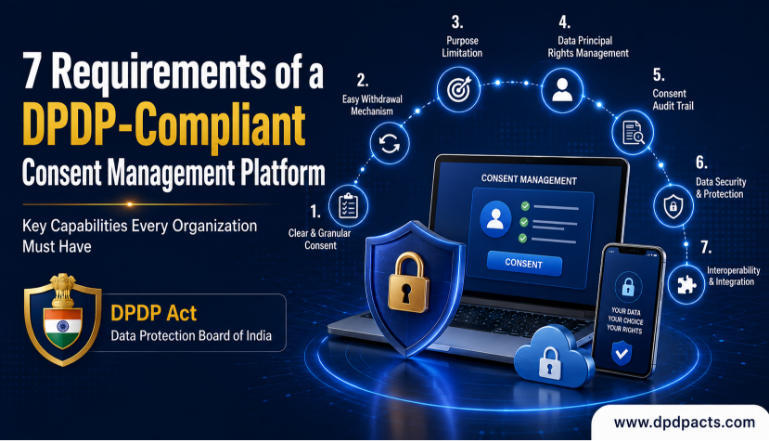
7 Requirements of a DPDP-Compliant Consent Management Platform

- Loading...
India’s data privacy landscape has entered a new phase with the Digital Personal Data Protection Act, 2023 (DPDP Act) and the Digital Personal Data Protection Rules, 2025.
Get a callback
For businesses collecting and processing digital personal data, consent is no longer simply a checkbox on a website form. Organisations need to think about how consent is requested, obtained, recorded, managed, reviewed, withdrawn and demonstrated.
This is where a DPDP-compliant Consent Management Platform (CMP) can become an important part of an organisation’s privacy and compliance infrastructure.
The DPDP Act defines a Consent Manager as a person registered with the Board that acts as a single point of contact enabling a Data Principal to give, manage, review and withdraw consent through an accessible, transparent and interoperable platform.
However, an important distinction should be made:
A consent management platform can support DPDP compliance, but simply installing a consent-management tool does not automatically make a business DPDP-compliant.
Compliance depends on the organisation’s overall data-processing practices, policies, security controls, notices, contracts, governance and implementation.
So, what should businesses look for when selecting or building a DPDP-compliant consent management platform?
Here are the 7 essential requirements.
What Is a Consent Management Platform?
A Consent Management Platform (CMP) is a technology system that helps an organisation manage consent and user preferences associated with personal data processing.
Depending on its design and scope, a CMP can help businesses:
- Display consent notices
- Capture affirmative consent
- Associate consent with specific purposes
- Maintain consent records
- Manage consent preferences
- Process consent withdrawal
- Maintain audit trails
- Support user rights
- Integrate with websites and applications
- Communicate consent changes to connected systems
- Provide evidence of consent when required
Under the DPDP Act, the concept of a Consent Manager is more specific than simply calling any privacy software a consent manager. The Act contemplates a registered Consent Manager that operates an accessible, transparent and interoperable platform.
The 2025 Rules further specify requirements relating to registration, records, security, independence and conflict of interest for Consent Managers.
Why Does a Business Need Consent Management Under DPDP?
The DPDP Act states that consent must be free, specific, informed, unconditional and unambiguous, with a clear affirmative action. Consent must also be limited to personal data necessary for the specified purpose.
The Act also gives the Data Principal the right to withdraw consent at any time when consent is the basis for processing, with the ease of withdrawal being comparable to the ease with which consent was given.
This creates a practical challenge.
Imagine a company has:
- 500,000 website visitors
- 50,000 registered users
- Multiple mobile applications
- Several marketing systems
- A CRM
- Email automation
- Analytics tools
- Customer-support software
- Multiple consent collection points
How does the organisation know:
Who gave consent?
What did they consent to?
When did they consent?
What notice did they see?
What purpose was the consent associated with?
Did they withdraw consent?
Did the downstream systems stop processing after withdrawal?
A properly designed consent management architecture should help answer these questions.
7 Essential Requirements of a DPDP-Compliant Consent Management Platform
1. Clear, Specific and Purpose-Based Consent Collection
The first and most fundamental requirement is the ability to collect consent in a manner consistent with the DPDP framework.
Under Section 6 of the DPDP Act, consent must be free, specific, informed, unconditional and unambiguous, and must involve a clear affirmative action. It must also be limited to the personal data necessary for the specified purpose.
Therefore, a good CMP should not simply display:
“I agree to the Terms and Privacy Policy.”
Instead, consent should be connected to specific processing purposes.
For example:
| Purpose | Data | Consent |
|---|---|---|
| Account creation | Name, email | Required |
| Marketing emails | Optional | |
| Promotional SMS | Mobile number | Optional |
| Personalised recommendations | User activity | Optional |
| Customer support | Contact information | As applicable |
This purpose-based structure makes it easier to distinguish between different processing activities.
What the platform should provide
A robust CMP should allow organisations to:
- Define processing purposes
- Create purpose-specific consent requests
- Identify the categories of personal data involved
- Capture affirmative action
- Record the version of the consent notice
- Record the date and time
- Record the source/channel through which consent was obtained
- Associate consent with the relevant Data Principal
Avoid bundled consent
One major objective should be to avoid unnecessarily bundling unrelated purposes into a single consent action.
For example:
“I agree to receive promotional emails, SMS, WhatsApp messages and personalised advertisements.”
A better approach may be to provide understandable, purpose-specific choices where separate consent is required.
2. Clear and Standalone Privacy Notice Management
Consent cannot be separated from the information provided to the individual before or along with the consent request.
The DPDP Act requires notice describing the personal data and purpose of processing, as well as information concerning the exercise of rights and complaints.
The DPDP Rules, 2025 add important detail around notice design. The explanatory note states that the notice should be clear, standalone and understandable, use simple language, identify the personal data being collected and describe the purpose of processing.
Therefore, a CMP should not merely store a checkbox result.
It should also be capable of associating consent with the relevant notice.
A strong consent record should ideally answer:
- What notice was presented?
- What version of the notice was presented?
- What personal data was described?
- What purpose was described?
- When was the notice presented?
- When was consent provided?
- What action did the user take?
This becomes particularly important if an organisation later needs to demonstrate how consent was obtained.
Why notice versioning matters
Suppose a company changes its privacy notice in January.
A user provided consent in December.
The organisation should not overwrite the historical record with the January version.
Instead, the system should maintain historical versions so that it can demonstrate what information was presented when consent was obtained.
3. Easy Consent Withdrawal and Preference Management
Consent management does not end when a user clicks “Accept.”
The DPDP Act expressly gives a Data Principal the right to withdraw consent at any time when consent is the basis for processing. The ease of withdrawal must be comparable to the ease with which consent was given.
This means a platform should provide a practical mechanism for:
Give consent → Review consent → Change preference → Withdraw consent
For example, if a user previously opted into promotional communication, the CMP should allow the user to change that preference without requiring an unnecessarily complicated process.
A good preference centre should allow users to:
- View active consents
- View withdrawn consents
- Change preferences
- Withdraw consent
- Review relevant purposes
- Understand what the consent relates to
- Access relevant information about the organisation
The 2025 Rules also state that a Consent Manager must enable Data Principals to give, manage, review and withdraw consent.
Why this is technically important
Withdrawal should not merely update a dashboard.
It should trigger the appropriate downstream actions.
For example:
User withdraws marketing consent
↓
CMP updates consent status
↓
CRM receives updated preference
↓
Email marketing platform suppresses the user
↓
SMS/WhatsApp marketing system updates its preference
This is why consent management needs integration rather than being an isolated website widget.
4. Immutable Consent Records and Audit Trails
One of the most important features of a DPDP-focused consent platform is the ability to maintain reliable evidence of consent.
Section 6 of the DPDP Act states that where consent is the basis of processing and a question arises in a proceeding, the Data Fiduciary is required to prove that the required notice was provided and consent was given in accordance with the Act and Rules.
This makes consent evidence extremely important.
A CMP should therefore maintain detailed records.
A consent record may include:
- Data Principal identifier
- Consent status
- Purpose
- Data category
- Date and time
- Consent source
- Notice version
- Consent version
- Affirmative action
- Withdrawal date/time
- Preference changes
- Relevant system/application
- Consent history
Example
A record could conceptually look like:
User: Customer ID 54892
Purpose: Promotional Email
Notice Version: 2.1
Action: Accepted
Date: 15 August 2026
Time: 11:32 AM
Source: Website registration
Status: Withdrawn
Withdrawal Date: 22 August 2026
This type of evidence can be valuable for privacy governance and audits.
5. Interoperability and API-Based Integration
A consent platform cannot be truly useful if consent exists only inside the platform.
Modern businesses operate multiple systems.
For example:
Website
↓
Consent Management Platform
↓
CRM
↓
Email Marketing
↓
Analytics
↓
Customer Support
↓
Advertising Platforms
If the CMP records a consent withdrawal but the CRM and marketing systems continue processing the data, the organisation may still have a compliance problem.
Therefore, interoperability is one of the most important technical requirements.
The DPDP Act specifically describes a Consent Manager as operating an accessible, transparent and interoperable platform.
The 2025 Rules also require the Consent Manager’s platform to be interoperable and independently certified against applicable data protection standards and assurance frameworks published by the Board.
Important technical capabilities include:
- REST APIs
- Webhooks
- SDKs
- JavaScript integration
- Mobile SDKs
- CRM integrations
- Marketing automation integrations
- Identity integration
- Consent synchronisation
- Real-time preference updates
- Machine-readable consent records
Example API workflow
A website collects consent.
The CMP creates the consent record.
The CMP sends the status to the CRM.
The CRM updates the customer’s communication preference.
The email platform receives the updated status.
The user subsequently withdraws consent.
The CMP sends the withdrawal event to connected systems.
The downstream systems suppress the relevant processing.
This creates a consent propagation architecture rather than simply a consent collection form.
6. Strong Security, Privacy and Access Controls
A Consent Management Platform itself handles information relating to personal data and consent preferences.
Consequently, security should be a fundamental requirement.
The 2025 Rules specifically require a Consent Manager to take reasonable security safeguards to prevent personal data breaches.
A strong platform should therefore incorporate security at multiple levels.
Recommended security controls include:
Encryption
Protect data in transit and at rest.
Role-Based Access Control
Not every employee should be able to view or modify consent records.
Multi-Factor Authentication
Administrative access should be appropriately protected.
Audit logging
Record important administrative and system activities.
API authentication
Secure integrations between the CMP and other systems.
Data minimisation
Do not collect unnecessary personal information merely because the platform technically can.
Backup and recovery
Consent records should be protected against accidental deletion or system failure.
Monitoring
Unusual access or suspicious activity should be detected and investigated.
Security is more than encryption
A platform should not be considered secure simply because it uses HTTPS.
Security also involves:
Identity + access control + encryption + logging + monitoring + vulnerability management + incident response + backup + governance
7. Transparency, Independence and Regulatory-Ready Governance
The seventh requirement is often overlooked.
A Consent Manager should not simply be technically capable; it also needs appropriate governance.
The 2025 Rules establish specific conditions for registration of a Consent Manager, including requirements around incorporation in India, technical/operational/financial capacity, a minimum net worth of ₹2 crore, integrity of management and independent certification of its interoperable platform and technical/organisational measures.
The Rules also impose obligations concerning:
- Maintaining consent records
- Providing Data Principal access
- Machine-readable records
- Security safeguards
- Acting in a fiduciary capacity toward the Data Principal
- Avoiding conflicts of interest
- Publishing specified ownership and management information
This means organisations evaluating a consent platform should look beyond the user interface.
Questions to ask a Consent Management Platform provider
- Is the platform interoperable?
- How are consent records stored?
- Can consent history be exported?
- Can users withdraw consent easily?
- How does withdrawal propagate to connected systems?
- How is notice versioning handled?
- How are APIs secured?
- What audit logs are available?
- What access controls exist?
- How is personal data protected?
- Does the provider have appropriate governance controls?
- Is the provider seeking/holding registration as a Consent Manager where applicable?
- Can the platform support future regulatory requirements?
DPDP Consent Management Platform: Essential Features at a Glance
| Requirement | What the Platform Should Do | Why It Matters |
| Purpose-based consent | Capture consent for defined purposes | Supports specific and informed consent |
| Notice management | Present and preserve relevant notices | Supports transparency and evidence |
| Consent withdrawal | Allow easy withdrawal | Required when consent is the processing basis |
| Audit trails | Preserve consent history | Helps demonstrate consent |
| Interoperability | Connect with business systems | Enables consent propagation |
| Security | Protect consent and personal data | Reduces privacy/security risks |
| Governance | Support transparency and accountability | Important for regulatory readiness |
What a DPDP-Compliant Consent Architecture Can Look Like
A practical architecture may look like this:
User / Data Principal
↓
Website / Mobile App
↓
Consent Management Layer
↓
Purpose + Notice + Consent
↓
Consent Record
↓
API / Integration Layer
↓
CRM | ERP | Marketing | Analytics | Support
↓
Preference Synchronisation
↓
Consent Withdrawal / Update
↓
Downstream Processing Stops or Changes Where Required
This architecture helps make consent an active part of the organisation’s data lifecycle.
Consent Management Platform vs Cookie Banner
These two concepts are often confused.
A cookie banner primarily deals with communicating choices around cookies and certain tracking technologies.
A DPDP-focused consent management platform can be much broader.
It may manage consent associated with:
- Customer registration
- Marketing communication
- Data processing purposes
- Mobile applications
- CRM processing
- Customer preferences
- Data-sharing workflows
- Consent withdrawal
- Consent records
- Audit trails
Therefore:
A cookie banner is not automatically a DPDP Consent Manager.
Similarly, adding a checkbox to a form does not automatically create a compliant consent-management system.
How to Choose a DPDP Consent Management Platform
Before selecting a CMP, businesses should evaluate it against both legal requirements and technical capabilities.
1. Compliance architecture
Does the platform support DPDP-specific consent and notice requirements?
2. Purpose management
Can different processing purposes be configured independently?
3. Consent evidence
Can the business demonstrate exactly what consent was given and when?
4. Withdrawal
Can users withdraw consent as easily as they provided it?
5. Integration
Can the platform connect with CRM, CMS, marketing and other business systems?
6. Scalability
Can it handle thousands or millions of consent records?
7. Security
What security controls protect consent information?
8. Auditability
Can administrators review consent history and system activity?
9. User experience
Can users understand and manage their choices without unnecessary complexity?
10. Regulatory readiness
Can the platform adapt as DPDP implementation requirements evolve?
Common Mistakes Businesses Should Avoid
Mistake 1: Treating a checkbox as consent management
A checkbox only captures an action.
It does not necessarily provide the complete evidence, lifecycle management and downstream controls required for effective consent governance.
Mistake 2: Making withdrawal difficult
If consent can be provided in one click but requires multiple emails and support tickets to withdraw, the process may create unnecessary compliance risk.
Mistake 3: Not storing notice versions
If the organisation cannot determine what notice was presented at the time consent was obtained, proving the historical consent context can become difficult.
Mistake 4: Keeping consent isolated
A CMP that does not communicate changes to CRM, marketing and other relevant systems may create a gap between the recorded preference and actual processing.
Mistake 5: Collecting excessive data
Consent does not automatically make every type of data collection appropriate.
The DPDP Act requires consent to be limited to personal data necessary for the specified purpose.
Mistake 6: Assuming the software equals compliance
Technology is only one component of compliance.
A business also needs appropriate:
- Policies
- Contracts
- Data governance
- Security controls
- Employee processes
- Vendor management
- Incident response
- Data retention practices
DPDP Consent Management: A Practical Implementation Roadmap
Businesses can approach implementation in phases.
Phase 1: Data Discovery
Identify:
- Personal data
- Collection points
- Processing purposes
- Systems
- Third-party processors
Phase 2: Consent Design
Define:
- Purposes
- Consent categories
- Notice content
- Consent language
- Withdrawal mechanisms
Phase 3: CMP Implementation
Deploy:
- Consent interfaces
- Preference centre
- Consent database
- Audit trails
- Notice management
Phase 4: Integration
Connect the CMP with:
- Website
- Mobile application
- CRM
- Marketing systems
- Customer support
- Other relevant processors
Phase 5: Testing
Test:
- Consent capture
- Withdrawal
- Preference changes
- API synchronisation
- User rights workflows
- Audit records
Phase 6: Continuous Monitoring
Regularly review:
- Consent records
- System integrations
- Privacy notices
- Vendor relationships
- Security
- Regulatory changes
Frequently Asked Questions
What is a DPDP-compliant Consent Management Platform?
A DPDP-compliant Consent Management Platform is a system designed to help organisations manage consent in accordance with applicable DPDP requirements, including consent collection, purpose management, records, review and withdrawal. However, using a CMP alone does not make an organisation fully DPDP-compliant.
Is a consent management platform mandatory for every business?
The DPDP Act recognises and regulates registered Consent Managers, but businesses should distinguish between using consent-management technology and being legally required to use a particular third-party platform. The appropriate compliance mechanism depends on the organisation’s processing activities and applicable provisions.
What should a DPDP consent platform record?
A robust system should preserve information such as consent status, purpose, notice, relevant timestamps and consent history. For a regulated Consent Manager, the 2025 Rules specifically require records of consents given, denied or withdrawn, notices preceding or accompanying consent requests, and certain data-sharing records.
How long should consent records be retained?
For a Consent Manager operating under the 2025 Rules, specified consent records must be maintained for at least seven years, or longer where agreed or required by law.
This should not be interpreted as a universal seven-year retention requirement for every organisation’s personal data or every consent record; retention must be assessed according to the applicable legal and operational context.
Can a consent management platform handle consent withdrawal?
Yes. Consent withdrawal and preference management should be core capabilities of a DPDP-focused platform. The DPDP Act specifically gives Data Principals the right to withdraw consent when consent is the basis for processing, with comparable ease to giving consent.
What is the difference between a CMP and a Consent Manager under DPDP?
A generic Consent Management Platform is a technology product.
A Consent Manager, as defined by the DPDP Act, is a person registered with the Board that provides an accessible, transparent and interoperable platform through which Data Principals can give, manage, review and withdraw consent.
Therefore, not every software product marketed as a “CMP” is necessarily a registered Consent Manager under the DPDP framework.
Conclusion
A DPDP-compliant consent management strategy is much more than adding a consent checkbox to a website.
A strong platform should support the complete consent lifecycle:
Notice → Consent → Record → Manage → Review → Withdraw → Synchronise → Audit
The seven core requirements are:
- Purpose-based and valid consent collection
- Clear and standalone notice management
- Easy consent withdrawal and preference management
- Reliable consent records and audit trails
- Interoperability and API-based integration
- Strong security and access controls
- Transparency, independence and regulatory-ready governance
The DPDP framework places significant emphasis on the ability of Data Principals to give, manage, review and withdraw consent, while the 2025 Rules provide additional requirements for registered Consent Managers concerning records, security, interoperability, independence and governance.
For businesses, the right approach is therefore not to ask only:
“Do we have a consent banner?”
Instead, the more important question is:
“Can we reliably demonstrate how consent was obtained, what it covered, how it was managed, and what happened when the user changed or withdrew that consent?”
That is the foundation of an effective DPDP consent-management strategy.
Suggested SEO Content Cluster
This article can also act as a pillar page for related DPDP topics:
- What Is a Consent Management Platform Under DPDP Act?
- DPDP Consent Management: Complete Guide for Businesses
- Consent Manager vs Consent Management Platform: What’s the Difference?
- How to Implement DPDP Consent Management on a Website
- DPDP Consent Withdrawal: What Businesses Need to Know
- DPDP Act Consent Requirements for Websites and Apps
- How to Maintain Consent Records Under DPDP
- DPDP Compliance Checklist for Indian Businesses
- Best Consent Management Platforms in India
- How Consent Management Software Helps With DPDP Compliance
Important compliance note
The DPDP Act and DPDP Rules have a phased commencement framework. The official MeitY page publishes the 2025 Rules and the enforcement timeline, so businesses should verify the applicable commencement date for a particular obligation rather than treating every provision as immediately enforceable.
For authoritative reference, the India Code version of the DPDP Act and the MeitY publication of the DPDP Rules, 2025 should be used alongside professional legal advice where necessary.