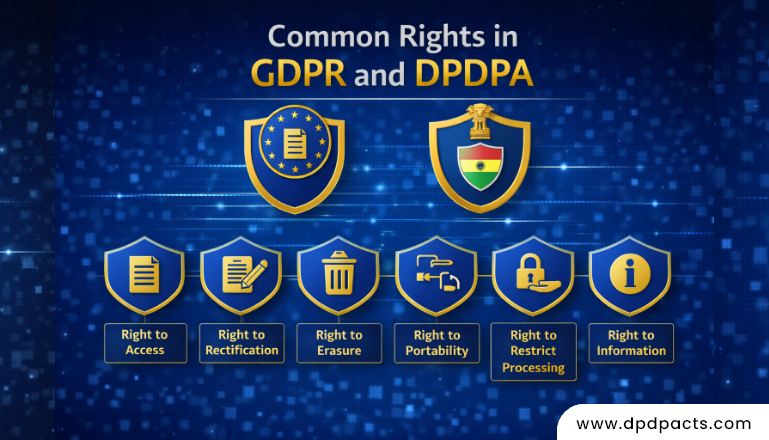
Common Rights in GDPR and DPDPA

- Loading...
In an increasingly digital world, personal data has become the backbone of modern economies. From social media interactions to online banking and e-commerce, individuals constantly share sensitive information. This growing dependence on data has made privacy protection a global priority. Two significant legal frameworks that aim to safeguard personal data are the General Data Protection Regulation (GDPR) of the European Union and India’s Digital Personal Data Protection Act (DPDPA).
Get a callback
Although these laws originate from different jurisdictions, they share a common philosophy: empowering individuals with rights over their personal data while ensuring organizations remain accountable. Understanding the common rights between GDPR and DPDPA is essential not only for legal compliance but also for building trust in the digital ecosystem.
Understanding the Core Philosophy
Both GDPR and DPDPA are rooted in key data protection principles:
- Transparency – Individuals must be informed about how their data is used
- Purpose Limitation – Data must be collected for a specific purpose only
- Data Minimization – Only necessary data should be collected
- Accountability – Organizations must be responsible for data protection
These principles translate into a set of rights that individuals can exercise.
Detailed Explanation of Common Rights
- Right to Information / Access
This right ensures that individuals are not kept in the dark about their data.
Organizations must clearly inform users about:
- What data is collected
- Why it is collected
- How long it will be stored
- Who it will be shared with
Additionally, individuals can request access to their data at any time.
Example: If you sign up for an online service, you can ask for a complete record of your stored personal information.
- Right to Correction / Rectification
Incorrect or outdated data can lead to serious consequences such as denial of services or identity issues.
Both GDPR and DPDPA allow individuals to:
- Correct inaccurate data
- Update outdated information
- Complete incomplete records
Example: If your name is misspelled in a database, you can request correction immediately.
- Right to Erasure / Deletion (Right to be Forgotten)
This right empowers individuals to have their data removed when it is no longer needed.
Conditions where deletion applies:
- Data is no longer necessary
- Consent has been withdrawn
- Data was unlawfully processed
Example: Deleting your account from an app should also remove your personal data from its servers.
- Right to Withdraw Consent
Consent is a cornerstone of both laws. However, it must not be permanent or binding.
Individuals can:
- Withdraw consent at any time
- Stop further data processing
Example: If you unsubscribe from marketing emails, the company must stop sending them.
- Right to Grievance Redressal
Both frameworks require organizations to establish mechanisms to address complaints.
This includes:
- Appointing grievance officers
- Providing clear complaint procedures
- Ensuring timely resolution
Example: If your data is misused, you can file a complaint and expect a response.
- Right to Nominate
This right ensures continuity of data rights even after death or incapacity.
Individuals can:
- Nominate a representative
- Allow them to exercise rights on their behalf
Example: A family member can request deletion of your data if you are no longer able to do so.
Comparison Table of Common Rights
| Right | GDPR | DPDPA | Description |
| Right to Access | Yes | Yes | Access personal data and processing details |
| Right to Correction | Yes | Yes | Correct or update inaccurate data |
| Right to Erasure | Yes | Yes | Request deletion of personal data |
| Right to Withdraw Consent | Yes | Yes | Stop data processing anytime |
| Right to Grievance Redressal | Yes | Yes | File complaints and seek resolution |
| Right to Nominate | Limited | Yes | Assign a representative for rights |
Key Differences (Brief Overview)
While the focus of this blog is on common rights, it’s important to note:
- GDPR offers additional rights like data portability and objection to profiling
- DPDPA focuses more on digital data only
- Nomination is more explicitly defined in DPDPA
Importance for Individuals and Businesses
For Individuals:
- Greater control over personal data
- Protection from misuse and exploitation
- Increased transparency
For Businesses:
- Need to implement compliance systems
- Build trust with users
- Avoid heavy penalties
Conclusion
The GDPR and DPDPA represent a significant step toward data democracy, where individuals are at the center of data governance. Despite geographical differences, both laws share a unified vision of protecting privacy and empowering users.
Understanding these common rights is crucial in today’s digital age. Whether you are a consumer, business owner, or policymaker, awareness of these rights ensures a safer and more transparent data environment.
Frequently Asked Questions
Q1. What are GDPR and DPDPA?
A1. They are data protection laws that regulate how personal data is collected and processed. Both aim to give individuals control over their personal information.
Q2. What is the right to access data?
A2. It allows individuals to know what data organizations hold about them. They can request and receive a copy of their personal data.
Q3. Can I correct my personal data?
A3. Yes, both laws allow correction of inaccurate or outdated data. You can also request completion of incomplete information.
Q4. What is the right to erasure?
A4. It allows individuals to request deletion of their data. This applies when data is no longer needed or consent is withdrawn.
Q5. Is consent mandatory under these laws?
A5. Yes, consent must be freely given, specific, and informed. Organizations must obtain clear permission before processing data.
Q6. Can I withdraw consent later?
A6. Yes, both GDPR and DPDPA allow withdrawal at any time. Organizations must stop processing your data after withdrawal.
Q7. What is grievance redressal?
A7. It is a mechanism to handle complaints about data misuse. Organizations must respond and resolve issues within a timeframe.
Q8. What does the right to nominate mean?
A8. It allows you to appoint someone to manage your data rights. This is useful in case of death or incapacity.
Q9. Are these rights applicable to all companies?
A9. They apply to organizations that process personal data. This includes both domestic and international entities.
Q10. Why are these rights important?
A10. They protect privacy and prevent misuse of personal data. They also ensure transparency and accountability in data handling.