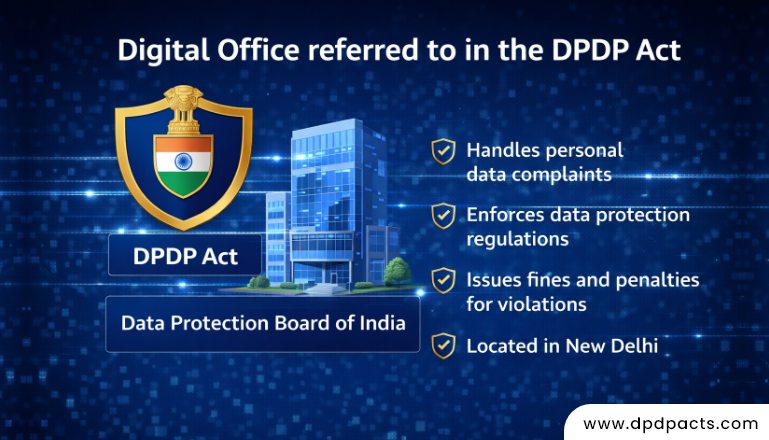
What is the Digital Office Referred to in the DPDP Act

- Loading...
India’s Digital Personal Data Protection (DPDP) Act, 2023 marks a transformative step in how personal data is governed, protected, and adjudicated in the digital age. One of its most innovative features is the concept of a “Digital Office”—a modern, technology-driven approach to regulatory functioning that reflects the realities of an increasingly online world.
Get a callback
This blog explores the meaning, structure, purpose, and implications of the Digital Office under the DPDP Act, along with its broader impact on governance, dispute resolution, and citizen empowerment.
Understanding the Concept of a Digital Office
Under the DPDP Act, a Digital Office refers to the operational framework of the Data Protection Board of India (DPBI) where all proceedings are conducted through online mechanisms rather than traditional physical setups.
This means that everything—from filing complaints to adjudication and appeals—is handled digitally. There is no requirement for physical presence, paperwork, or in-person hearings unless specifically required under exceptional circumstances.
The Digital Office is not merely a digitized version of a traditional office. Instead, it is a digital-first adjudicatory ecosystem, built to handle data protection issues efficiently in a country with over a billion digital users.
Why Introduce a Digital Office?
The introduction of a Digital Office is rooted in the need to address several systemic challenges:
- Explosion of Digital Data
With rapid internet penetration, India has seen an exponential rise in data generation. This has naturally led to an increase in:
- Data breaches
- Privacy violations
- Misuse of personal data
Handling such a massive volume of complaints through traditional systems would be inefficient and slow.
- Need for Speed and Efficiency
Legal and quasi-judicial processes in India are often criticized for delays. The Digital Office aims to:
- Reduce case backlogs
- Enable faster decision-making
- Streamline workflows
- Accessibility for Citizens
A digital platform allows individuals from any part of India to:
- File complaints
- Participate in hearings
- Access decisions
This eliminates geographical barriers and promotes inclusivity.
Key Features of the Digital Office
- Fully Online Proceedings
All stages of the adjudication process are conducted digitally:
- Complaint filing
- Notices and summons
- Evidence submission
- Hearings
- Final orders
This ensures a seamless, paperless process.
- Virtual Hearings and Adjudication
The DPBI conducts hearings via:
- Video conferencing
- Online dispute resolution (ODR) platforms
This allows parties to participate remotely without traveling.
- Techno-Legal Framework
The Act empowers the Board to adopt “techno-legal measures”, including:
- Digital authentication of documents
- Electronic submission of evidence
- Online examination of witnesses under oath
This merges legal rigor with technological efficiency.
- Online Dispute Resolution (ODR)
The Digital Office leverages ODR tools to:
- Resolve disputes faster
- Encourage settlements
- Reduce adversarial litigation
ODR platforms may include automated workflows, AI-assisted case management, and digital mediation tools.
- Digital Summons and Notices
The Board can:
- Issue summons electronically
- Notify parties via digital communication channels
- Conduct examinations without requiring physical presence
This is a major shift from traditional legal processes.
- Integration with Appellate Mechanisms
The digital approach extends beyond the Board:
- Appeals go to the Telecom Disputes Settlement and Appellate Tribunal (TDSAT)
- Further appeals can be made to the Supreme Court
This creates a digitally enabled three-tier system:
- Data Protection Board
- TDSAT
- Supreme Court
Legal Backing: DPDP Rules, 2025
The DPDP Rules, 2025 further strengthen the Digital Office concept by mandating that:
- The Board must function digitally
- Physical presence is not mandatory
- Digital tools must be used for all proceedings
These rules ensure that the Digital Office is not optional but a core structural feature of the data protection regime.
How the Digital Office Works: Step-by-Step
Let’s break down how a typical case might proceed:
Step 1: Filing a Complaint
A data principal (individual) files a complaint online regarding:
- Unauthorized data usage
- Data breach
- Failure to honor consent
Step 2: Registration and Scrutiny
The system:
- Registers the complaint
- Conducts preliminary checks
- Assigns it to the appropriate authority
Step 3: Issuance of Notice
The concerned entity (data fiduciary) receives:
- A digital notice
- Instructions for response
Step 4: Submission of Evidence
Both parties submit:
- Documents
- Statements
- Digital records
All submissions are uploaded online.
Step 5: Virtual Hearing
If required, a hearing is conducted via video conferencing.
Step 6: Decision
The Board issues a digitally signed order, which is:
- Accessible online
- Legally binding
Step 7: Appeal
If dissatisfied, parties can appeal digitally to TDSAT.
Advantages of the Digital Office
- Speed and Efficiency
Digital workflows significantly reduce:
- Processing time
- Administrative delays
- Cost Reduction
Eliminates:
- Travel expenses
- Legal overheads associated with physical proceedings
- Accessibility and Inclusion
Enables participation from:
- Remote areas
- Individuals with mobility challenges
- Transparency
Digital records ensure:
- Traceability of actions
- Accountability in decision-making
- Scalability
The system can handle:
- Large volumes of cases
- Nationwide participation
- Environmentally Friendly
A paperless system reduces:
- Paper consumption
- Carbon footprint
Challenges and Concerns
Despite its advantages, the Digital Office model also faces certain challenges:
- Digital Divide
Not all citizens have:
- Reliable internet access
- Digital literacy
This could limit participation.
- Cybersecurity Risks
Handling sensitive data online raises concerns about:
- Data breaches
- System vulnerabilities
- Technical Glitches
System failures or connectivity issues may:
- Delay hearings
- Affect fairness
- Legal Adaptation
Traditional legal practices must adapt to:
- Digital evidence
- Virtual hearings
Global Context: A Step Toward Digital Governance
India’s Digital Office model aligns with global trends where governments are:
- Adopting e-governance
- Leveraging digital courts
- Implementing online dispute resolution
Countries like the UK, Singapore, and Estonia have already embraced similar systems, making India’s approach both timely and forward-looking.
Future Implications
The Digital Office under the DPDP Act could serve as a blueprint for:
- Other regulatory bodies
- Consumer dispute forums
- Judicial reforms
It represents a shift toward:
- Decentralized justice
- Technology-enabled governance
- Citizen-centric systems
Conclusion
The concept of a Digital Office in the DPDP Act, 2023 is more than just an administrative innovation—it is a paradigm shift in how legal and regulatory processes are conducted in India.
By enabling fully digital proceedings, leveraging advanced technologies, and ensuring accessibility, the Digital Office transforms the Data Protection Board of India into a modern, agile, and efficient institution.
While challenges like the digital divide and cybersecurity risks remain, the overall framework holds immense promise. It sets the stage for a future where justice is not only fair but also fast, accessible, and technologically empowered.
Frequently Asked Questions
Q1. What is a Digital Office under the DPDP Act?
A1. A Digital Office is an online operational framework where the Data Protection Board conducts all its proceedings digitally, without requiring physical presence.
Q2. Is physical attendance required in Digital Office proceedings?
A2. No, all proceedings are designed to be conducted online, including hearings and evidence submission.
Q3. What types of cases are handled in the Digital Office?
A3. Cases related to data protection, privacy violations, consent breaches, and data misuse are handled.
Q4. How can a complaint be filed?
A4. Complaints can be filed through an online portal provided by the Data Protection Board.
Q5. What is the role of ODR in the Digital Office?
A5. Online Dispute Resolution (ODR) tools help resolve disputes quickly through digital mediation and adjudication.
Q6. Can evidence be submitted digitally?
A6. Yes, all documents, records, and evidence can be submitted electronically.
Q7. What happens after the Board’s decision?
A7. Parties can appeal to TDSAT and further to the Supreme Court if needed.
Q8. Is the Digital Office secure?
A8. The system is designed with cybersecurity measures, but like any digital platform, it requires robust safeguards.
Q9. What are the main benefits of the Digital Office?
A9. It offers speed, accessibility, cost savings, transparency, and scalability.
Q10. What challenges does the Digital Office face?
A10. Key challenges include the digital divide, cybersecurity risks, and technical issues.