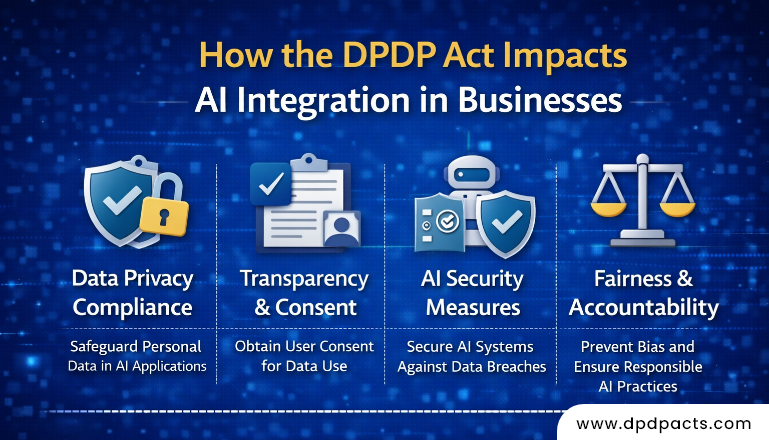
How the DPDP Act Impacts AI Integration in Businesses

- Loading...
With the rapid adoption of Artificial Intelligence (AI) across industries, businesses are leveraging data-driven technologies to automate processes, enhance customer experience, and improve decision-making. However, in India, the introduction of the Digital Personal Data Protection (DPDP) Act has significantly changed how companies collect, process, and store personal data—especially when AI systems are involved.
Get a callback
Quick Overview: DPDP Act vs AI Compliance Requirements
| DPDP Requirement | What It Means for AI Systems | Action Required by Businesses |
| Purpose Limitation | Data must be collected for a specific purpose | Define clear AI use cases before data collection |
| User Consent | Mandatory user approval for data usage | Implement consent management systems |
| Data Minimization | Only necessary data can be collected | Reduce dataset size & avoid unnecessary inputs |
| Transparency | Users must understand AI-driven decisions | Use explainable AI (XAI) models |
| Data Retention Limits | Data cannot be stored indefinitely | Set data deletion or anonymization timelines |
| Data Security | Protect personal data from breaches | Apply encryption & access control |
| Cross-Border Transfer | Data transfer limited to approved countries | Use compliant cloud infrastructure |
| User Rights | Users can access, correct, or delete their data | Build user data access & control mechanisms |
Understanding the DPDP Act in the Context of AI
The DPDP Act regulates the processing of digital personal data while safeguarding individual privacy. Since AI systems depend heavily on data, any organization using AI must comply with these legal frameworks.
Key Impacts of DPDP Act on AI Integration
1. Data Collection Limitations
AI systems must now operate within defined data collection boundaries, ensuring all data serves a lawful purpose.
2. Consent-Driven Data Processing
Explicit user consent is mandatory before using personal data in AI models, making legacy datasets potentially non-compliant.
3. Data Minimization Principle
Organizations must shift from “collect everything” to “collect what is necessary,” impacting AI training efficiency.
4. Automated Decision-Making Transparency
Businesses must explain how AI systems make decisions, especially in critical areas like finance, hiring, and healthcare.
5. Data Retention Restrictions
AI datasets must follow strict storage timelines, requiring periodic deletion or anonymization.
6. Cross-Border Data Transfer Controls
AI systems hosted on global servers must comply with government-approved jurisdictions.
Detailed Compliance Checklist for AI-Driven Companies
| Compliance Area | Checklist Item | Priority Level |
| Data Audit | Identify all personal data used in AI | High |
| Consent Management | Record and manage user permissions | High |
| Privacy by Design | Build AI systems with data protection in mind | High |
| AI Transparency | Document AI decision-making processes | Medium |
| DPIA (Risk Assessment) | Conduct risk analysis before deployment | High |
| Vendor Compliance | Ensure third-party AI tools follow DPDP | Medium |
| Data Security | Implement encryption and access controls | High |
| Data Lifecycle Management | Define storage, usage, and deletion policies | High |
Best Practices for AI Compliance Under DPDP
- Use anonymized or synthetic data for AI training
- Implement role-based access control (RBAC)
- Maintain clear AI documentation
- Regularly update privacy policies
- Conduct quarterly compliance audits
Challenges Businesses May Face
- Reduced access to large datasets
- Increased compliance costs
- Need for legal + technical expertise
- Slower AI deployment cycles
Conclusion
The DPDP Act is reshaping how Artificial Intelligence is implemented in India. While it introduces stricter compliance requirements, it also pushes organizations toward ethical, transparent, and privacy-first AI systems.
Businesses that adapt early will gain a competitive advantage by building trust, credibility, and long-term sustainability.