Consent Manager Under DPDP Act

- Loading...
In today’s digital-first world, personal data has become one of the most valuable assets. From signing up on apps to making online purchases, users constantly share sensitive information—often without fully understanding where it goes or how it’s used. Recognizing the urgent need to protect citizens’ data, India introduced the Digital Personal Data Protection (DPDP) Act, a landmark regulation that reshapes how personal data is handled.
Get a callback
At the heart of this transformation lies a powerful concept: the Consent Manager. Designed as a secure, user-centric intermediary, a Consent Manager empowers individuals to take back control of their data while ensuring organizations remain compliant with the law.
Let’s explore what a Consent Manager is, why it matters, and how it is set to redefine privacy and trust in India’s digital ecosystem.
What is a Consent Manager?
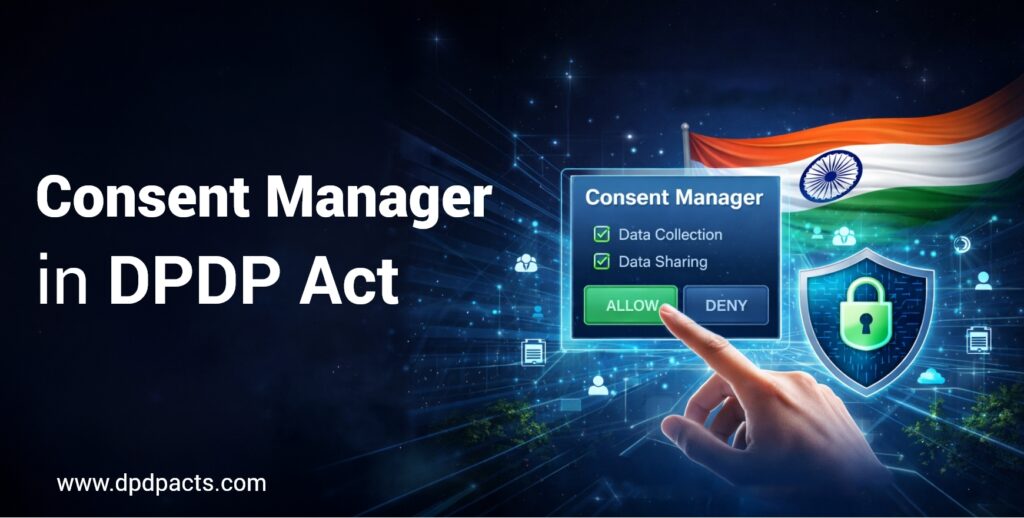
A Consent Manager is a registered entity under the DPDP Act that acts as a bridge between Data Principals (users) and Data Fiduciaries (organizations that process data). Think of it as a digital dashboard where users can easily grant, review, modify, or withdraw consent for data sharing—all in one place.
Instead of managing permissions separately across dozens of apps and services, users gain centralized control over their personal data.
Why Consent Managers Matter
Most users today face “consent fatigue.” We blindly click “Accept” on lengthy privacy policies without understanding the implications. Consent Managers aim to fix this broken system by making consent:
- Transparent
- Granular
- Revocable
- Trackable
This is not just a technical shift—it’s a philosophical one, placing individuals at the center of the data economy.
Key Roles and Responsibilities of a Consent Manager
- Centralized Control for Users
Consent Managers act as a single point of contact where users can manage permissions across multiple platforms. Whether it’s a fintech app, healthcare provider, or e-commerce site, all consent decisions can be handled from one unified interface. This drastically reduces confusion and increases awareness.
- Mandatory Registration
To operate legally, a Consent Manager must be registered with the Data Protection Board of India. This ensures:
- Regulatory oversight
- Standardized operations
- Trustworthiness
Only approved entities can perform this role, adding a layer of accountability.
- Interoperability Through Standardization
Consent Managers must operate using standardized APIs. This ensures seamless communication between different organizations and platforms.
The benefit?
Users can manage consent across services without compatibility issues—creating a smooth, interconnected ecosystem.
- Grievance Redressal Mechanism
If something goes wrong—unauthorized data sharing, misuse, or confusion—users can file complaints directly through the Consent Manager platform. This feature transforms Consent Managers into user advocates, not just technical intermediaries.
- No Data Monetization
One of the most critical aspects is that Consent Managers are data-blind conduits.
They:
- Do not access user data
- Do not store or analyze personal information beyond consent logs
- Cannot monetize data
This ensures their role remains neutral and focused purely on facilitating consent.
- Fiduciary Responsibility
Consent Managers act in a fiduciary capacity, meaning they are legally bound to act in the best interests of the user. If they fail, they can be held accountable—making trust a foundational requirement, not just a promise.
How Consent Managers Operate
Understanding how Consent Managers function helps clarify their real-world impact.
- Just-in-Time Consent
Instead of overwhelming users with long policies upfront, Consent Managers enable just-in-time notices.
For example:
- When an app needs access to your location, you get a clear, contextual request explaining why.
This improves clarity and informed decision-making.
- Consent Record Keeping
Every action—granting, modifying, or withdrawing consent—is logged securely.
These logs are:
- Auditable
- Tamper-proof
- Accessible to users
This ensures complete transparency and traceability.
- Empowering User Rights
Consent Managers give users the ability to:
- View what data is shared
- Correct inaccurate data
- Withdraw consent anytime
This aligns perfectly with the DPDP Act’s emphasis on user autonomy.
Benefits of Consent Managers
For Users
- Greater control over personal data
- Reduced risk of misuse
- Simplified privacy management
- Improved trust in digital platforms
For Businesses
- Easier compliance with DPDP regulations
- Reduced legal risks
- Standardized consent processes
- Increased customer trust
For the Digital Ecosystem
- Stronger privacy framework
- Better data governance
- Increased innovation with trust
Challenges and Considerations
While Consent Managers offer immense potential, they also come with challenges:
- User Awareness
For Consent Managers to succeed, users must understand how to use them. Without awareness, even the best systems fail.
- Technical Integration
Organizations need to integrate with standardized APIs, which may require infrastructure upgrades.
- Trust Building
Since Consent Managers handle sensitive consent flows, building trust is critical. Transparency and strong security practices will be key.
- Regulatory Evolution
As the DPDP Act evolves, Consent Managers must adapt to new rules and compliance requirements.
Consent Managers and Privacy by Design
Consent Managers are a cornerstone of Privacy by Design, a principle that embeds privacy into systems from the ground up.
Instead of treating privacy as an afterthought, Consent Managers ensure:
- Data minimization
- Purpose limitation
- User-first design
This shifts the entire ecosystem toward ethical data practices.
Real-World Use Cases
- Fintech
Users can control which financial apps access their banking data.
- Healthcare
Patients can manage consent for sharing medical records across providers.
- E-commerce
Shoppers can decide how their browsing and purchase data is used.
- EdTech
Students can control how their academic data is shared with institutions.
The Future of Consent Management in India
India is building one of the most advanced digital ecosystems in the world. Consent Managers will play a pivotal role in shaping this future.
We can expect:
- AI-driven consent insights
- Cross-border data compliance
- Integration with digital identity systems
- Greater user empowerment
Over time, Consent Managers could become as essential as email or mobile apps—an everyday tool for digital life.
Conclusion
The introduction of Consent Managers under the DPDP Act marks a turning point in India’s data protection journey. By giving users centralized control, ensuring transparency, and enforcing accountability, they create a more balanced relationship between individuals and organizations.
In a world where data is power, Consent Managers ensure that power stays where it belongs—with the people.
Frequently Asked Questions (FAQs)
Q1. What is a Consent Manager under the DPDP Act?
A1. A Consent Manager is a registered entity that helps users manage their data-sharing consent with organizations through a unified platform.
Q2. Is using a Consent Manager mandatory?
A2. No, but it is highly beneficial for users who want better control over their personal data.
Q3. Can Consent Managers access my personal data?
A3. No, they act as data-blind intermediaries and only manage consent records.
Q4. Who regulates Consent Managers in India?
A4. They are regulated by the Data Protection Board of India.
Q5. Can I withdraw consent anytime?
A5. Yes, users can withdraw consent at any time through the Consent Manager platform.
Q6. What happens after I withdraw consent?
A6. Organizations must stop processing your data unless required by law.
Q7. Are Consent Managers secure?
A7. Yes, they are required to maintain high security standards and auditable logs.
Q8. How do Consent Managers help businesses?
A8. They simplify compliance, reduce legal risks, and build customer trust.
Q9. Can I file complaints through a Consent Manager?
A9. Yes, most platforms provide grievance redressal mechanisms.
Q10. What is the future of Consent Managers in India?
A10. They are expected to become a core part of India’s digital infrastructure, enhancing privacy and user control.